
Piezas mecanizadas por CNC para maquinaria de construcción: por qué y cómo se utilizan.
In extreme operating environments, the reliability of heavy machinery (such as excavators, loaders, bulldozers, and cranes) directly dictates construction efficiency and equipment uptime. Failures in hydraulic systems, bearing wear, or fractures in critical fasteners not only result in exorbitant downtime and repair costs, but can also trigger severe safety accidents.
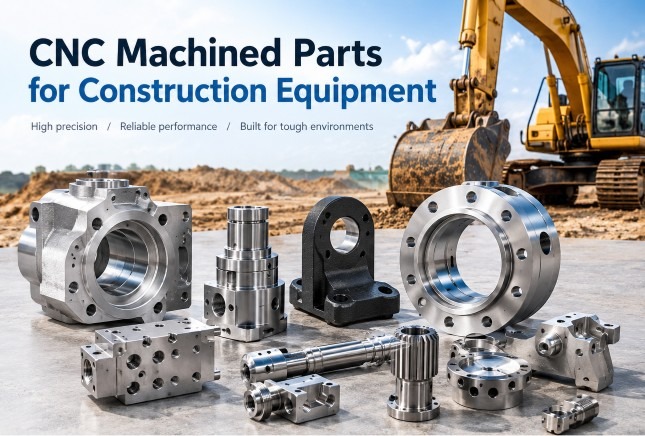
To ensure equipment operates stably under heavy loads, strong impacts, high dust levels, and extreme temperature variations, an increasing number of original equipment manufacturers and aftermarket component suppliers are choosing high-precision CNC machining technology. This article delivers an in-depth analysis of manufacturing standards and selection logic for pieza mecanizada CNCs para equipos de construcción across key application components, material selection, tolerance control, process comparisons, and quality inspection.
Índice
Which Heavy Machinery Parts para construcción Can Be CNC Machined?
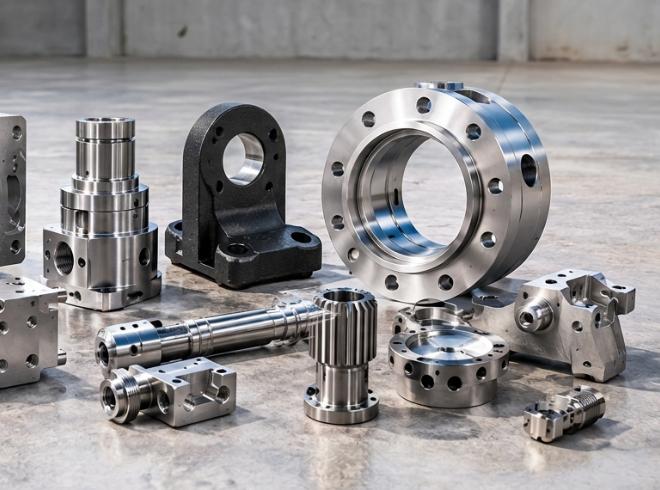
Mecanizado CNC is capable of working on various metal components found in large machines including pins, bushes, shafts, hubs, hydraulic parts, mounts, and connectors. Identifying if the component can be machined via CNC Machining will depend on some elements that include structure, material, size, tolerance, and quantity.
Pasadores y bujes
Pins and bushes are commonly employed in articulating joints, linkages, and attachments of machines such as excavators and loaders. CNC machining ensures that outer diameter, inner diameter, shoulders, and lubricating grooves of these components meet high precision in terms of fit tolerance, concentricity, and surface finish.
Shafts and Hubs
Shafts and hubs usually perform functions related to rotation, power transfer, and bearing and gear mountings. Turning and milling by CNC machines deal with characteristics like outside diameter, shaft shoulders, keyways, threading, and mountings. In case of shafts and hubs, concentricity, dimensional accuracy, and fit tolerances become machining specifications.
Componentes del sistema hidráulico
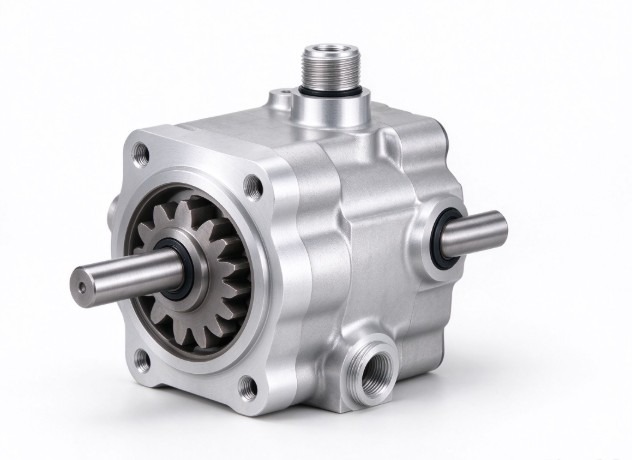
CNC machining can be applied to the fabrication of hydraulic valve bodies, manifolds, fittings, adapters, and housings since they have precision holes, threads, sealing interfaces, and inner fluid passages that require precision control in terms of location of holes, threading, sealing, and fluid passages.
Mounting Brackets and Structural Connectors
Mounting plates, mounting bases, and flanges generally include mounting holes, tapped holes, locating holes, grooves, and mounting surfaces. The CNC milling, drilling, and tapping processes produce such features from CAD designs or engineering drawings, emphasizing the retention of hole alignment and mounting dimensions.
Housings, Adapters, and Custom Connectors
In cases where housings, mechanical interfaces, and connector designs deviate from standard forms, CNC machining can allow for certain dimensions related to machine placement and space restrictions. This process is especially advantageous for custom work.
Undercarriage and Other Components
Select wheel hubs, connectors, and shaft components within undercarriage and travel mechanisms can also be CNC machined. However, whether large structural components are suitable for CNC must be evaluated based on part size, material, structural complexity, and machining requirements.
Which Types of Heavy Machinery Use CNC Machined Parts?
CNC machined parts are deployed across various types of heavy machinery. Because different equipment operates through distinct mechanical structures, their required CNC parts vary accordingly across connection, drive, hydraulic, and mounting systems.
Excavadores
Excavator working attachments will endure substantial loading, impact, and movement requirements, thus necessitating exact dimensions and tolerance levels.
Components like pins, bushings, shafts, mounting hardware, hydraulics, connections, housing, and adapters will be produced using CNC machining technology. Among these, pins and bushings require rigorous control over fit tolerances, concentricity, and wear resistance.
Cargadoras de ruedas
Wheel loaders endure continuous mechanical loads during digging, transport, and dumping operations. CNC machined components are widely integrated into their linkage systems, connecting mechanisms, power transmissions, and hydraulics.
Common parts include pins, bushings, shafts, hubs, hydraulic components, and mounting connectors.
Bulldozers
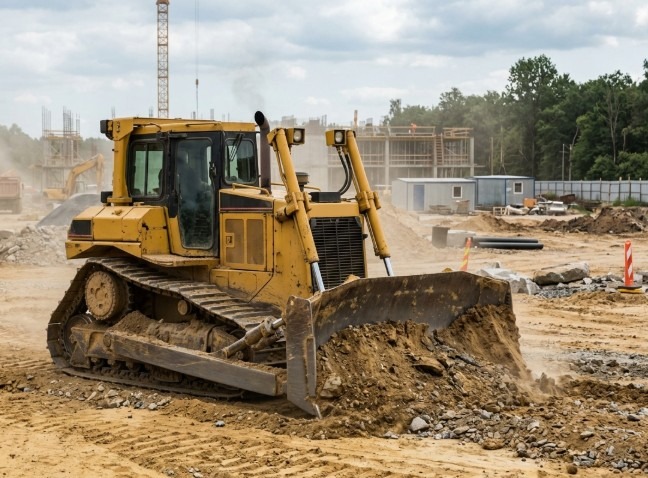
The working attachments, undercarriage, and drive mechanisms of bulldozers have many mechanical joints and moving parts. For particular design purposes, certain shafts, pins, bushes, joints, and mounting parts can be machined through CNC Turning, CNC Milling, CNC Drilling, or CNC Boring.
Grúas
These consist of many mechanical joints, slewing mechanisms, and load-supporting parts, which have to be engineered very accurately for all its parts.
CNC milling makes various shafts, bushings, mounting plates, connecting parts, enclosures, and special fittings to specifications of the engineering drawings.
Drilling Rigs and Foundation Equipment
The drilling machines, pile drivers, and other such foundation machinery have the combination of mechanical drive systems, hydraulic systems, and connection systems. Therefore, they use a wide variety of CNC machined components such as shafts, connections, adapters, housing, hydraulic mechanical parts, and mounting assemblies that need accuracy in dimensions or geometries.
Why Choose CNC Machining for Equipos de construcción ¿Partes?
For heavy equipment manufacturing, parts need to be able to endure heavy load-bearing, heavy impacts, and severe operating environments while meeting tough assembly and sealing specifications. Compared to casting or conventional machining methods, CNC machining provides critical core benefits because:
Superior Batch Dimensional Consistency for OEM Assembly
The parts used in the heavy machinery industry should be able to fit together in a repeated manner and be interchangeable in high-pressure environments.
Being operated through strict digital coding and engineering drawings, CNC machining ensures the required tolerance is maintained within the micron level (within ±0.01 mm).
This ensures that there are no cumulative human errors, which will result in identical interchangeability for both prototypes and thousands of production parts.
Efficient Execution of Complex Geometries Beyond Traditional Limits
Hydraulic valve blocks and transmission housings in heavy machinery frequently feature dense hole patterns, intricate internal oil channels, multi-angle pockets, and precision threads.
Traditional machining struggles to process these features in a single setup. Multi-axis CNC machine tools perform multi-surface cutting and contouring through one clamping operation. This ensures the accuracy and high-pressure sealing of the internal intersecting passages with minimized accumulation of tolerances due to re-clamping.
High Flexibility for Customized Engineering Requirements
Heavy machinery frequently requires non-standard modifications, aftermarket replacements, and specialized field customizations. CNC machining is capable of interpreting 2D drawings or 3D CAD drawings for precise cutting operations, while also having the ability to assist in reverse engineering from actual examples. By not requiring any expensive tooling, engineers will be able to quickly design customized parts depending on their functionality and material hardness.
Full Lifecycle Support from Prototyping to Volume Production
In new equipment development, prototype testing serves as a critical phase for design verification. Using CNC machining for production will ensure low cost and quick production of prototype units that will be used in validating the fit, performing stress tests, and evaluating functionality of the parts.
With validation and finalization of the design, production will easily and effortlessly scale to high-volume production without changing the manufacturing process.
CNC machining offers micron accuracy, dense material, complex geometry handling, and outstanding manufacturing versatility, thus, playing a vital role in heavy machinery manufacturing solutions.
Common Materials Used for Heavy Machinery CNC Parts
For heavy machinery CNC parts production and purchasing, Mecanizado CNC con el medio ambiente have an impact on the fatigue life, maximum load limit, and the operational availability of the machinery.
Because heavy machinery is exposed to heavy loads, shock loading, heavy wear and tear, and harsh outdoor environments, general terms such as “carbon steel” or “stainless steel” are inadequate for engineering purposes. The metallic materials that are used in heavy machinery CNC machining are detailed below according to their grades and applications:
| Categoría de material | Common Specific Grades | Propiedades y ventajas del material | Typical Heavy Machinery CNC Components |
| Alloy Steel & High-Strength Carbon Steel | • 4140 (42CrMo4) • 4340 (40CrNiMo) • 8620 (20CrNiMo) • 1045 (45# Steel) | • Exceptionally high tensile and yield strength • Outstanding hardenability; highly suitable for carburizing or induction hardening • Superior impact and fatigue resistance | Heavy-duty drive shafts, main kingpins, heavy-load gears, planetary gear carriers, track drive sprocket assemblies |
| Acero Inoxidable | • 17-4 PH (SUS630) • 316L • 304 | • 17-4 PH is a precipitation-hardening stainless steel offering both high strength and excellent corrosion resistance • 316L/304 provide superior acid/alkali resistance and outdoor rust prevention | Hydraulic valve spools for outdoor/marine equipment, sensor housings, high-pressure fluid fittings, corrosion-resistant valve manifolds |
| Copper Alloys & Bronze | • C93200 (SAE 660) • Aluminum Bronze (QAl9-4) • Brass (C36000) | • Excellent self-lubricating properties and wear resistance • Low coefficient of friction with high resistance to galling and seizure | Pin bushings, hydraulic piston pump slipper shoes, thrust washers, spherical bearing liners |
| Aleaciones de aluminio | • 7075-T6 • 6061-T6 | • 7075 delivers ultra-high strength comparable to structural steel at a light weight • 6061 exhibits good machinability, corrosion resistance, and weldability | Cabin control valve bodies, lightweight shock-absorbing brackets, Electronic Control Unit (ECU) protective enclosures |
How Are Heavy Machinery CNC Parts Manufactured?
In the heavy machinery field, producing high-quality CNC components goes beyond basic cutting; it represents a systematic engineering workflow incorporating strict engineering reviews, precision manufacturing, and end-to-end quality control.
A typical custom manufacturing process for heavy machinery CNC parts comprises six key steps:
Drawing Review & DFM Evaluation
Before any manufacturing process begins, 2D drawings and 3D CAD designs are carefully reviewed for material grades, critical fit tolerances, thread requirements, and heat treating. Detecting any possible design issues at this stage guarantees that all technical aspects are 100% manufacturable.
Material Procurement & Inspection
High-quality bars, plates, or forgings are sourced in strict accordance with engineering specifications. Mill Test Certificates (MTC) are verified for critical load-bearing parts, accompanied by raw material spectrometer re-testing when necessary to guarantee impact and fatigue resistance from the source.
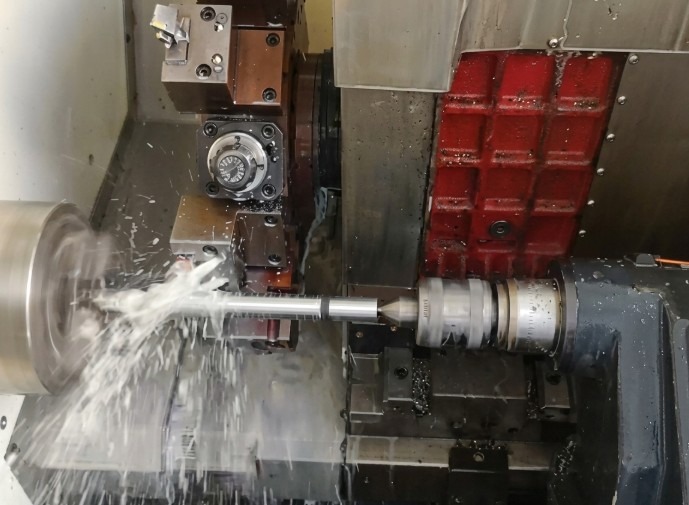
Multi-Axis CNC Turning & Precision Milling
Components are machined based on their geometric characteristics:
Shaft Components (Pins, Drive Shafts): Machined via CNC turning to guarantee outer diameter tolerances and concentricity.
Structural Parts / Valve Bodies (Brackets, Hydraulic Manifolds): Processed via multi-axis CNC milling to produce flat surfaces and complex internal oil channels.
Complex Composite Parts: Manufactured on turn-mill multitasking centers to execute turning and milling in a single setup, minimizing accumulated tolerances.
Drilling, Precision Boring & Tapping
Dedicated operations handle connecting and mating features, including deep oil-hole drilling, bearing-seat precision boring, and high-pressure thread tapping. Hole positions, relative location tolerances, and internal surface finishes are tightly controlled to eliminate burrs and guarantee stress-free assembly.
Heat Treatment & Surface Hardening
The semi-finished components will be improved depending on the operational parameters such as pins and gears which require case hardening or induction hardening for improved surface hardness (HRC 58–62); whereas hydraulic cylinders and components will have hard chrome plating or black oxide or spray coating.
Full Dimensional Inspection & Delivery
Final inspection of micrometers, thread gauges, and CMM machines is done for critical dimensions, geometric tolerances, and surface finish. Certified components go through ultrasonic cleaning and anti-rust packaging before being shipped to the client.
How to Choose the Right Heavy Machinery CNC Part Supplier?
Because heavy machinery parts operate continuously under high loads and harsh environments, supplier selection directly influences equipment uptime and brand market reputation. Evaluating and selecting a high-quality CNC machining supplier involves the following core dimensions:
Robust Quality Certifications & Traceability
Prefer facilities which are certified under ISO 9001:2015. The suppliers should ensure quality traceability in full supply chain process and should be able to issue MTC, Heat Treatment Report, and FAIR with the shipment.
Advanced Multi-Axis Machining Equipment
Heavy machinery parts often involve cutting high-hardness steels and complex geometries. Suppliers should be equipped with 4-axis/5-axis CNC milling machines and turn-mill multitasking centers to maintain micron-level tolerances (±0.01 mm) and high concentricity.
Stable Heat Treatment & Post-Processing Supply Chain
Components such as pins and gears require carburization, induction hardening, and hard chromium plating. A well-developed and compliant post-production chain must be available from the suppliers to assure the required surface hardness (HRC 58–62).
Precision Inspection Equipment (CMM & NDT)
Apart from traditional measuring instruments such as calipers and thread gauges, it is necessary that the supplier use Coordinate Measuring Machine (CMM) to perform full geometrical tolerance testing and provide non-destructive testing (NDT/crack detection) facilities for stress bearing parts.
Extensive Heavy Equipment Experience & DFM Support
Suppliers well-versed in heavy machinery operating environments can optimize structural designs and reduce manufacturing costs during the Design for Manufacturability (DFM) phase, backed by rapid responsiveness from initial prototyping through volume delivery.
Why Choose KENENG as Your Heavy Machinery CNC Manufacturing Partner?
Operating a 3,000+ square meter CNC machining facility staffed by over 60 professional engineers and technicians, Keneng specializes in manufacturing high-durability, high-precision components and tailored solutions for the heavy machinery industry.
Addressing industry pain points such as high impact loads, heavy duty cycles, tight tolerances, and strict delivery schedules, we provide the following core manufacturing capabilities:
Precisión a nivel micrométrico: Equipped with 3/4/5-axis milling centers, turn-mill multitasking machines, and Swiss-type lathes, achieving precision fit tolerances down to ±0.0127mm to satisfy demanding assembly standards for hydraulic components, pins, and bearing housings.
Heavy-Duty Materials & Heat Treatment Expertise: Experienced with machining over 50 material grades, including 4140/4340 alloy steel, 1045 steel, 17-4 PH stainless steel, and C93200 bronze, along with quenching, tempering, case hardening or induction hardening to ensure high resistance to wear and high impact strength.
Acabado de superficies integral: Complete surface treatment services, including hard chrome plating, hard coat anodizing, zinc/nickel plating, black oxide and powder coating, providing maximum corrosion resistance outdoors.
Advanced Material Grades & Heat Treatment: Experienced with machining over 50 material grades, including 4140/4340 alloy steel, 1045 steel, 17-4 PH stainless steel, and C93200 bronze, along with quenching, tempering, case hardening or induction hardening to ensure high resistance to wear and high impact strength.
One-Stop Surface Treatments: Complete surface treatment services, including hard chrome plating, hard coat anodizing, zinc/nickel plating, black oxide and powder coating, providing maximum corrosion resistance outdoors.
Free DFM Optimization & Flexible Lead Times: Engineering team delivers complimentary Design for Manufacturability (DFM) evaluations to help reduce production costs; flexible support scales from 1-piece prototypes to full volume production, with expedited turnaround as fast as 3 business days.
Rigorous Quality Control & Complete Traceability: Full dimensional inspection utilizing Coordinate Measuring Machines (CMM), accompanied by Mill Test Certificates (MTC) and full dimensional reports with every shipment to guarantee zero-defect delivery.
Conclusión
High operational conditions of heavy machinery make extremely tough demands concerning material choice, precision machining, and subsequent processing. The cooperation with a professional factory which works under ISO quality control standards and has CNC machines for machining and inspection ensures longevity and prevents failures.
Looking for custom precision CNC machined parts for your heavy machinery? Contacta hoy mismo con KENENG. to receive professional Design for Manufacturability (DFM) analysis and a fast quotation!