
Fabricación OEM frente a fabricación a medida de piezas CNC: ¿Cuál elegir?
CNC machining is used to manufacture precision components for industries like cars, aircraft, medical products, electronics, and industrial equipment. When sourcing Piezas CNC, businesses usually compare OEM manufacturing with custom manufacturing. Both can produce accurate parts. But they differ in design responsibility, production flexibility, cost structure, and application requirements.
Knowing how OEM and custom manufacturing work can help businesses select the right production method for their projects, optimize manufacturing costs, and maintain consistent product quality.
Índice
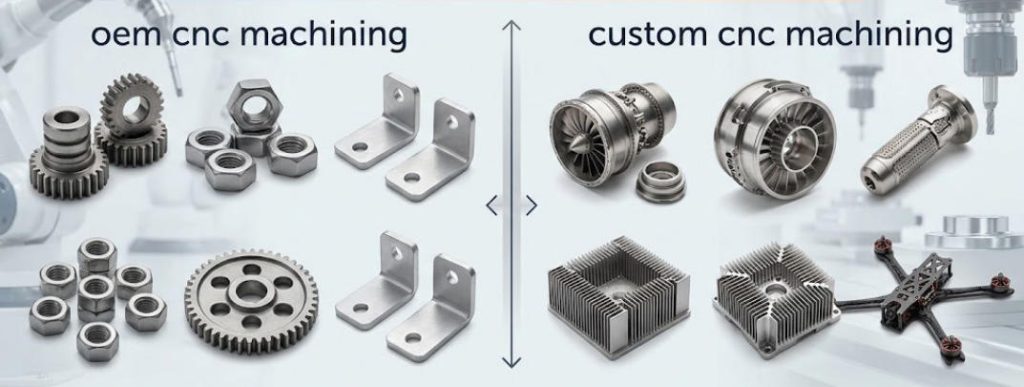
Cómo entender la OEM Manufacturing in CNC Parts
OEM means Original Equipment Manufacturer. In CNC work, OEM manufacturing typically means making parts from a customer’s set design. That design may come as engineering specs, technical drawings, or clear shop requirements. The parts then go into the customer’s finished product. They are usually sold under the customer’s brand.
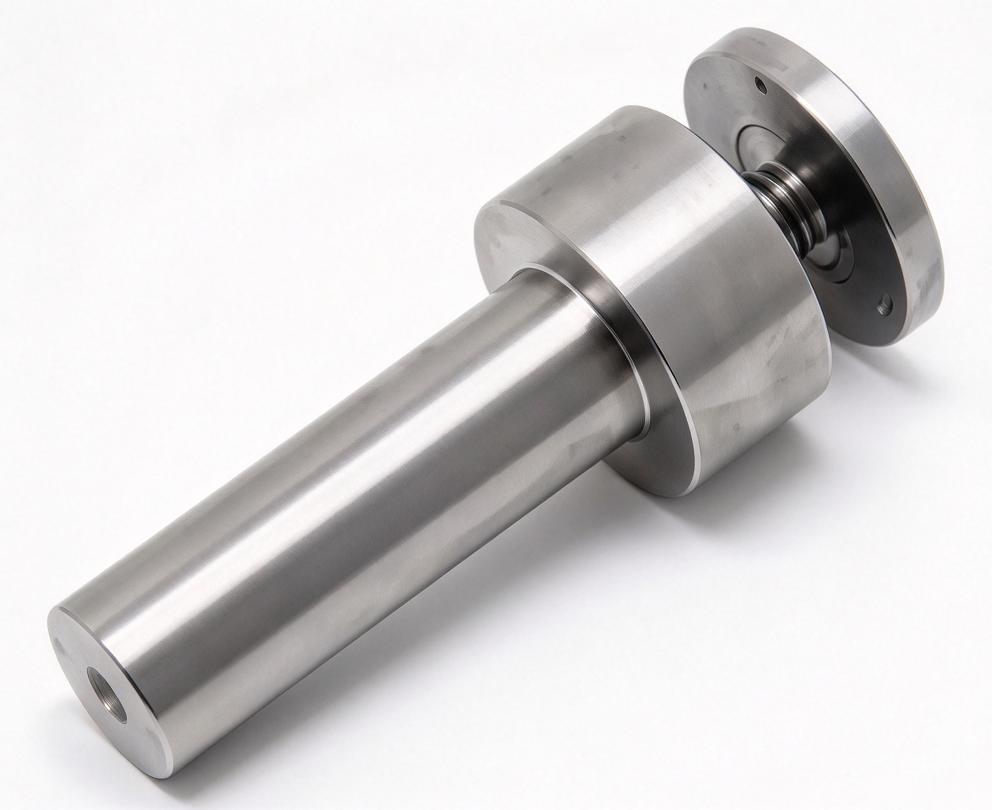
Piezas CNC OEM are often made using CNC milling, CNC turning, drilling, grinding, and final finishing steps. For some orders, the supplier may also handle material sourcing, surface treatment, assembly, inspection, and packing.
Características principales
- Set production rules: OEM suppliers follow approved drawings, tolerances, material limits, and quality checks. This helps keep results similar from lot to lot.
- Ongoing supply ties: OEM work fits buyers that place repeat orders and need reliable deliveries.
- Capacity for different order sizes: Some suppliers can support early prototypes, small runs, or full production. The exact size depends on their equipment and skill.
- Steady quality: Using set methods and inspection checks supports stable dimensions and repeat output.
Cómo entender la Custom Manufacturing in CNC Parts
Custom manufacturing means CNC parts are made to meet a specific customer brief. It is not based only on a fixed, standard product design. The customer’s needs can include one-off shapes, special materials, unusual sizes, complex features, or performance limits tied to the customer’s real use.
Fabricación CNC personalizada matters when standard parts do not meet the required fit, function, measurements, or operating conditions for a project.
The process can start from a simple idea, a 3D CAD file, an engineering sketch, a physical sample, or a full performance spec. After that, the shop reviews the work with the client. They check if it can be made well, pick materials that fit, decide on cutting steps, and set what will be inspected later.
Características principales
- Design that can bend to the need: Clients can request sizes, shapes, tolerances, surface finishes, and other details for their real use.
- Hands-on engineering support: The shop may share DFM notes to speed up machining and help lower manufacturing cost.
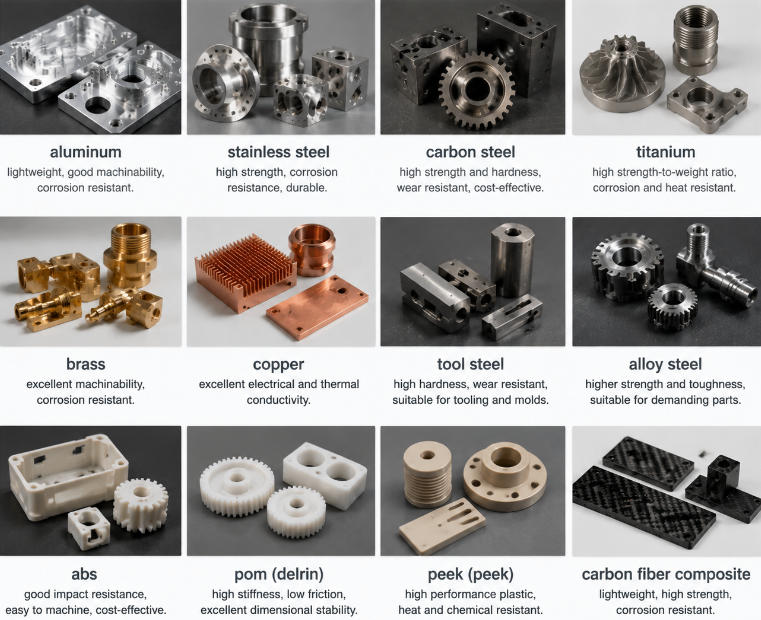
- Elección de materiales: With the right machines and know-how, custom CNC work can be done on aluminum, stainless steel, brass, titanium, engineering plastics, and more.
- Different order sizes: The same setup can handle prototypes, spare parts, special parts, and small batch jobs.
- Made for a specific use: Parts can be tuned for tough conditions. Examples include high load, heat swings, corrosion risk, or tight mounting space.
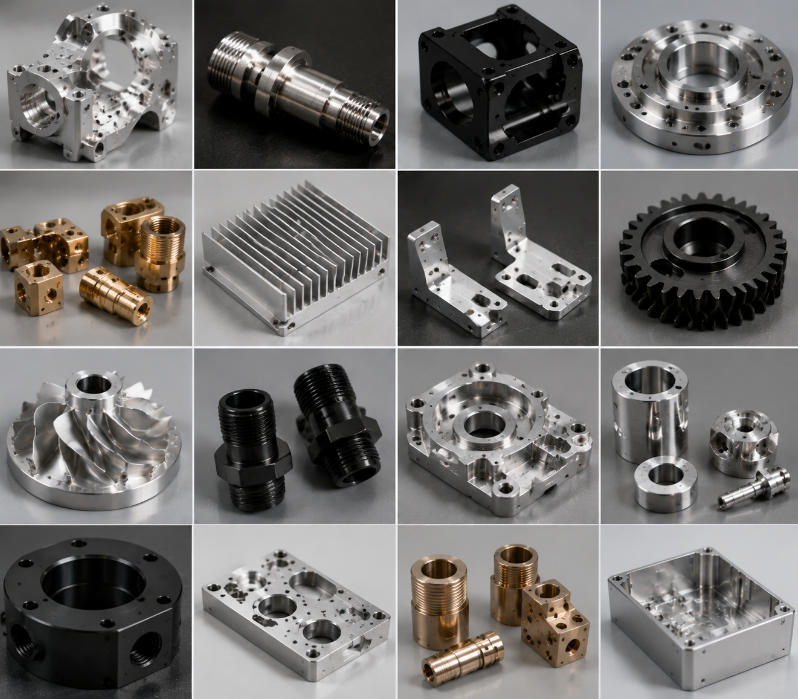
Key Differences Between OEM and Custom Manufacturing in CNC Parts
1. Design Requirements and Engineering Responsibility
One of the main differences between OEM and custom manufacturing is how product designs and engineering requirements are established.
Fabricación OEM
With OEM manufacturing, CNC parts are made from the customer’s existing drawings, CAD models, specs, and quality rules. The manufacturer aims to match the approved data and keep each run consistent.
This fits firms that have already finished product design and just need a steady supplier for built parts.
Fabricación personalizada
Custom manufacturing allows more room to shape the component to match what the customer asked for. A client might send a concept, a sample, an early drawing, or a full CAD model. Then, based on the shop’s skill set, the maker can also share DFM suggestions.
This is often used when normal parts do not meet the needed function or the required dimensions.
2. Personalización y flexibilidad de diseño
OEM manufacturing usually focuses on staying inside the approved design. Custom manufacturing focuses more on fitting the component to the planned application.
CNC OEM maquinado partes can include tough shapes and strict specs, but updates often need formal checks and sign off. Custom manufacturing can support more frequent design changes while the product is still being worked out.
A machinery maker might buy OEM shafts by using drawings that are already set, since work is meant to run again and again. A robotics firm that is building a fresh robotic arm may ask for CNC brackets made to its own specs, including its exact dimensions, bolt hole layout, and weight targets.
The key distinction is not that OEM parts cannot be customized, but that custom manufacturing usually provides more flexibility when a design is still being developed or needs substantial modification.
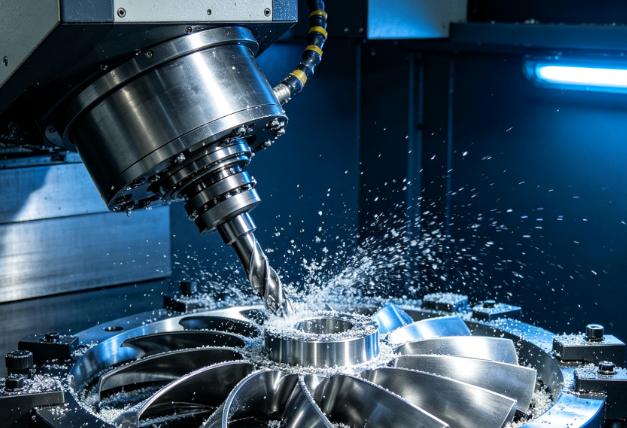
3. Volumen de producción y escalabilidad
Production volume influences the suitability and cost-effectiveness of each manufacturing method.
OEM manufacturing is usually tied to repeat buys. After the machining steps are locked in, along with tooling and inspection checks, the same part can be built again with steady results. When orders grow, the cost per unit can drop because setup work is spread across more pieces.
Custom manufacturing often shows up in prototypes, small runs, special repair parts, and work done in lower quantities. Still, custom CNC can handle higher output if the design is stable, the machines are set up well, and the production plan supports it.
Businesses should evaluate both immediate demand and expected future orders before choosing a supplier or production strategy.
4. Estructura de costos y precios
The cost difference between OEM and custom manufacturing depends on part complexity, order quantity, material selection, machining time, and engineering requirements.
OEM production may benefit from existing machining programs, established processes, and repeat orders. These factors can reduce recurring setup expenses and improve cost predictability.
Custom manufacturing may involve additional costs for engineering consultation, prototype development, programming, specialized tooling, and design validation. Low-volume orders can also have higher per-unit costs because fixed expenses are spread across fewer parts.
| Factor de costo | Fabricación OEM | Fabricación personalizada |
| Initial engineering | Often lower when designs are finalized | May be higher if design support is required |
| Programación y configuración | Can be reused for repeat orders | May require new programming and setup |
| Costo unitario | Often competitive for recurring or larger orders | Depends on complexity and order quantity |
| Prototyping expenses | May be limited for established designs | Can be significant during development |
| Design revision costs | Formal revisions may require revalidation | Iterations may be easier but still add costs |
| Eficiencia de costos a largo plazo | Strong for stable, repeat production | Strong when customization solves specific application needs |
To compare quotations accurately, businesses should consider the total cost of ownership, including inspection, finishing, transportation, inventory, and potential rework, not just the initial unit price.
5. Planificación del tiempo de entrega y de la producción
Lead time depends on design readiness, supplier capacity, material availability, machining complexity, and quality requirements.
OEM production can give steadier lead times for repeat work. That is because the drawings are often already approved, the machining program is already made, and inspection steps are already documented.
Custom production can take longer. There may be design checks, DFM review, a prototype build, tests, and then updates. On the other hand, a small CNC personalizado maquinado parte can finish sooner than an OEM part that has tight quality rules.
To reduce delays, customers should provide complete technical information, confirm material specifications, clarify delivery quantities, and approve drawings before production begins.
6. Requisitos de control de calidad e inspección
Both OEM and custom manufacturing require effective quality control, but the inspection process may differ according to the project’s objectives.
OEM manufacturing focuses on producing parts that consistently meet approved specifications. Manufacturers may use coordinate measuring machines (CMMs), micrometers, calipers, optical measurement systems, and other inspection equipment to verify dimensions and tolerances.
Custom manufacturing may require additional inspection during prototype development and design validation. First-article inspection, material certification, surface roughness measurement, and specialized performance testing may be necessary for certain applications.
| Factor de calidad | Fabricación OEM | Fabricación personalizada |
| Objetivo principal | Maintain repeatability and specification compliance | Verify that the design meets application requirements |
| Enfoque de la inspección | Dimensional consistency across production batches | Dimensional accuracy and design validation |
| Documentación | Approved drawings, inspection reports, and quality records | Prototype results, revised drawings, and validation records |
| Gestión del cambio | Controlled specification revisions | Design iterations and updated acceptance criteria |
| Planeación de calidad | Established inspection procedures where applicable | Inspection plans may evolve during development |
For both approaches, customers should clearly define tolerances, material grades, surface finishes, traceability requirements, and acceptance criteria before production starts.
7. Selección de materiales y procesos de mecanizado
OEM and custom CNC manufacturing can use the same basic machining routes. These can include milling, turning, drilling, grinding, and careful finishing. The difference is often how the material and the process are chosen in the first place.
For OEM work, material grades and machining steps are usually spelled out in the existing product needs. The supplier follows those rules unless a change is approved through the proper channel.
For custom work, there may be more chances to test other material options and machining approaches. For example, a customer might weigh aluminio vs acero inoxidable, based on weight, strength, rust resistance, and cost.
Material swaps should not happen only to cut costs. You must first confirm that the part still meets the needed performance level. Also, get customer sign off before you change anything.
8. Applications of OEM and Custom Manufacturing in CNC Parts
OEM and custom manufacturing support a wide range of industries, and the two approaches can be used within the same supply chain.
| Experiencia | Fabricación CNC OEM | Fabricación CNC personalizada |
| Motorium | Engine components, shafts, housings, and mounting brackets | Prototype parts, specialized fixtures, and unique fittings |
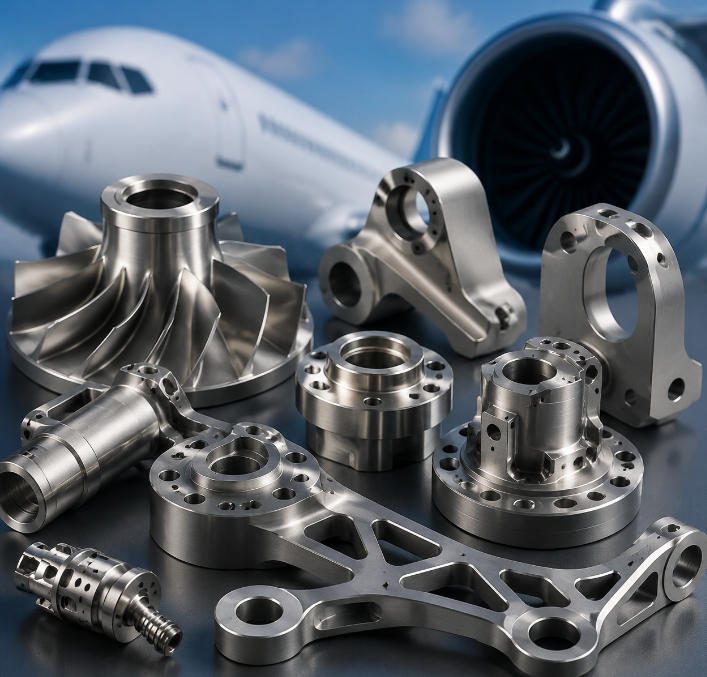
| Aeroespacial | Recurring precision components made to approved specifications | Development parts and specialized lightweight components |
| equipos médicos | Components manufactured to established technical drawings | Custom instrument parts and prototype device components |
| Electrónica | Enclosures, heat sinks, connectors, and structural components | Specialized housings and customized thermal-management parts |
| Maquinarias industriales | Repeat-production gears, couplings, and equipment housings | Unique machine parts and application-specific replacement components |
| Robótica | Standardized production components and actuator parts | Custom grippers, robotic interfaces, and lightweight structural parts |
The appropriate approach depends on the component’s design status, intended function, production requirements, and applicable industry standards.
9. Communication and Supplier Collaboration
Communication is important in both manufacturing models, but the collaboration process may differ.
In OEM manufacturing, the talks usually follow production needs. Teams share schedules, quality results, and checks for spec fit. They also review order forecasts. Engineering change control is handled in a structured way. If the supplier stays steady, output tends to be more uniform, and delivery dates are more dependable.
In custom manufacturing, the work can start sooner. Customers and suppliers may talk during product development. CAD models may be reviewed. Feasibility for machining is tested early. Material options are compared. Tolerance needs get defined. Then prototypes are built, and the design is refined again and again.
When evaluating a CNC supplier, businesses should consider:
- CNC equipment and machining capabilities
- Engineering help and DFM input
- Material sourcing and trace records
- Inspection tools and test steps
- Production capacity and on time delivery
- Response speed and change handling
A supplier that understands the customer’s technical and commercial objectives can help reduce manufacturing risks under either approach.
Tabla comparativa resumida de OEM and Custom Manufacturing in CNC Parts
| Factor de comparación | Fabricación OEM | Fabricación personalizada |
| Definición | Produces CNC parts according to established customer specifications and approved designs. | Produces CNC parts tailored to specific customer requirements or applications. |
| Requerimientos de diseño | Usually follows finalized CAD models, engineering drawings, and technical specifications. | Can begin with a concept, sample, preliminary drawing, or complete CAD model. |
| Nivel de personalización | Focuses on compliance with approved designs; modifications require appropriate approval. | Offers greater flexibility for unique dimensions, geometries, and functional features. |
| Soporte de Ingeniería | Primarily focuses on production feasibility and specification compliance. | May include design consultation, design-for-manufacturability (DFM), and prototype development. |
| Volumen de producción | Often suitable for recurring orders and scalable production. | Often suitable for prototypes, small batches, and specialized components; can also support mass production. |
| Costo de instalación inicial | May be lower for repeat orders when machining programs and processes already exist. | May be higher when new programming, tooling, or engineering work is required. |
| Costo unitario | Often becomes more competitive as production volume increases. | Depends on design complexity, order quantity, material, and machining time. |
| Tiempo De Espera | Can be shorter and more predictable for repeat orders. | May require additional time for design reviews, prototyping, and revisions. |
| Control de calidad | Emphasizes consistency and compliance with approved specifications. | Emphasizes dimensional accuracy and validation against application-specific requirements. |
| Selección de Materiales | Usually follows established material specifications or approved alternatives. | May allow broader evaluation of materials based on strength, weight, corrosion resistance, and cost. |
| Cambios de diseño | Generally managed through formal engineering change procedures. | Often accommodates design iterations, although changes can increase costs and lead times. |
| Flujo de trabajo de producción | Relies on established machining programs and standardized processes where applicable. | May require new machining strategies and process planning for individual designs. |
| Aplicaciones principales | Recurring automotive components, equipment housings, shafts, and standardized production parts. | Prototypes, custom machine parts, specialized brackets, robotic components, and unique replacement parts. |
| Ventajas principales | Repeatability, production efficiency, predictable quality, and potential volume cost savings. | Design flexibility, application-specific solutions, and support for product innovation. |
| Limitaciones principales | Less convenient when frequent design changes are needed. | Engineering costs, setup expenses, and unit prices may be higher for complex, low-volume orders. |
| La mejor opción para | Businesses with finalized designs and stable, ongoing component demand. | Businesses developing new products or requiring specialized CNC components. |
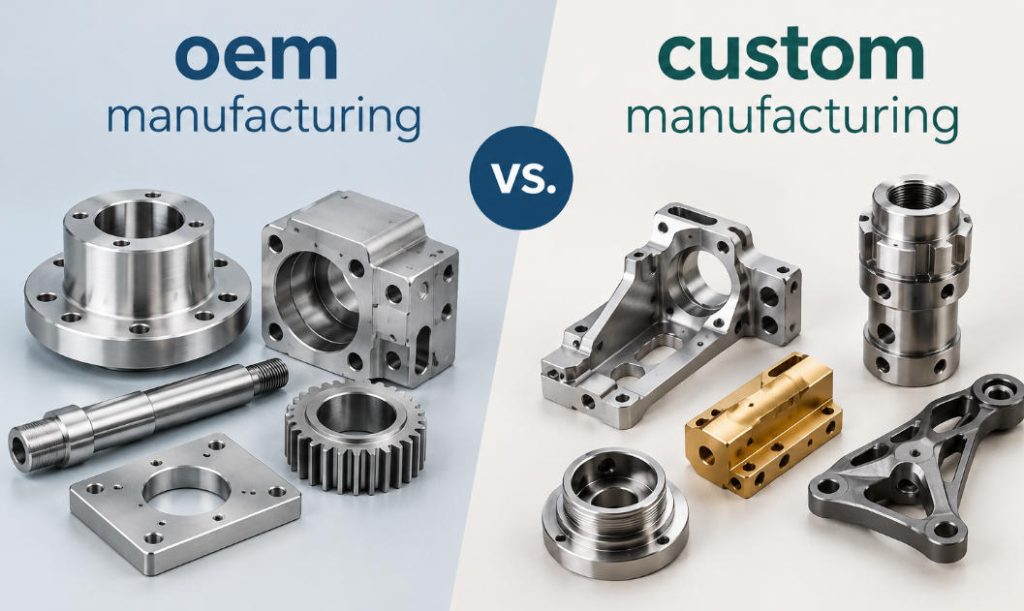
How to Choose Between OEM and Custom Manufacturing por la Piezas CNC
The right choice depends on your project’s stage, technical requirements, and production goals.
Choose OEM manufacturing cuando:
- Your product design and technical drawings are finalized.
- You need repeatable components for ongoing production.
- Consistent quality and reliable supply are major priorities.
- Your production volume is expected to increase.
- You want to establish a long-term manufacturing partnership.
Choose custom manufacturing cuando:
- You are developing a new product or prototype.
- Your component requires unique dimensions or geometries.
- Existing standard parts cannot meet your application needs.
- You need support with material selection or design optimization.
- Your order involves specialized or low-volume components.
In many cases, the most effective strategy combines both methods: custom manufacturing for initial development and validation, followed by OEM production after the design is finalized.
Conclusión
OEM and custom manufacturing both work well for CNC parts. But they have different priorities. The main contrasts involve design responsibility, customization flexibility, production volume, cost structure, lead time, quality control, and engineering collaboration.
OEM manufacturing usually fits designs that are already set and situations where the same parts are made many times. Custom manufacturing works better when you need room to adjust, especially for unique parts and product work that is still changing. There is no single winner in all cases. The best fit depends on the project’s technical requirements, order quantities, budget, and long-term plans.
When you look at these factors closely and work with a skilled CNC manufacturer, you can often get steadier part quality, keep production costs in line and make your delivery process smoother.