
Как толщина материала влияет на характеристики штампованных деталей?
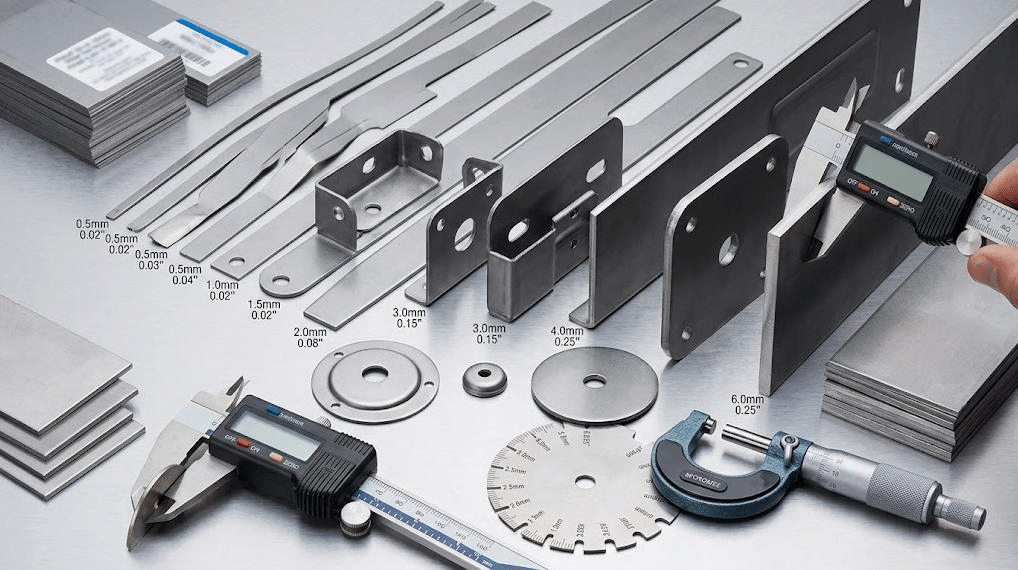
Material thickness is a major driver of how well металлические штамповочные детали perform. It also affects durability, dimensional accuracy and manufacturing cost. In automotive manufacturing, electronics, aerospace, industrial equipment, and home appliances, choosing the appropriate material thickness matters. It helps produce components that meet specific strength, weight, and functional requirements.
До точность штамповки деталей, support brackets, metal housings, and deep-drawn components, thickness changes the way sheet metal behaves during the stamping process. It alters forming force needs. It also affects spring back, surface quality, dimensional consistency, and resistance to deformation. When manufacturers understand these relationships, they can fine-tune their stamping processes. That can cut down on defects and support stable component performance.
Содержание
Why Material Thickness это важно в штамповке металла
Metal stamping reshapes flat sheet into parts using blanking, punching, bending, embossing, and deep drawing. Throughout these steps, the metal sees compressive, tensile, and shear forces. The sizes of those forces shift with the part shape and the way the job is set up.
Thickness controls how much metal is available to resist those forces. In many cases, thicker stock adds stiffness and helps the part carry loads. Thinner material can be better when weight needs to drop, material use should improve, or the forming needs more flexibility.
Thickness is not the only variable. Material grade, tensile strength, ductility, grain direction, tool design, and stamping conditions all affect results. Teams need to review these factors as a group to reach the right mix of performance and ease of manufacturing.
Key Aspects of Stamping Parts Affected by Material Thickness
1. Прочность и несущая способность
Material thickness affects strength and load-bearing in stamping parts. If two parts use the same material, a thicker version usually resists bending and shape change better under load.
For instance, a thicker steel bracket can often take higher forces than a near identical thinner one. That is why thicker sheet metal fits structural support parts, mounting areas, reinforcement plates, and components that see repeated mechanical stress.
The outcome depends on the loading mode. Under simplified assumptions, the bending stiffness of a flat plate rises with the cube of its thickness. So even a modest thickness change can lead to a clear improvement in bending rigidity.
Nevertheless, making the material thicker usually raises total mass and raw material expenses. When weight matters most, some makers choose high-strength steel and then adjust the shape. They may also add ribs or switch to formed profiles so the part meets the needed performance without adding extra thickness.
2. Точность размеров и допуски
Material thickness can affect how close a stamped part stays to its target size. This shows up during bending, forming, and deep drawing.
As thickness goes up, forming often needs more force. That can increase the stress on the stamping dies and the press. If the tooling was built for a different thickness, you can see extra deformation, changes in final dimensions, or faster tool wear.
Even within one sheet, thickness can vary. Those swings can shift the final size of stamped parts. During bending, thickness changes alter where the neutral axis sits. This then changes how bend radius and bend angle relate to the final shape.
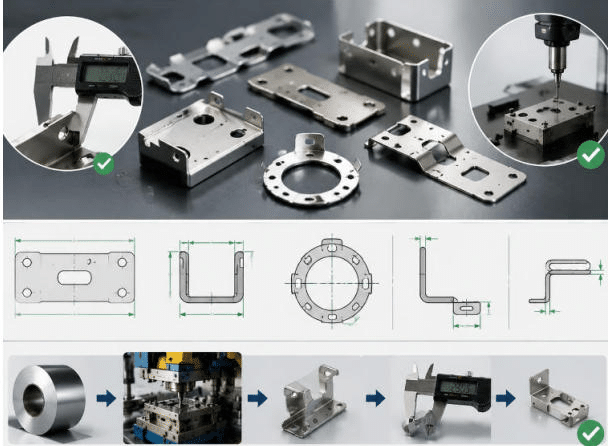
To keep dimensions steady, manufacturers should check sheet thickness before use. They should also set die clearance well, plan for springback, and choose process tolerances that make sense. These steps matter a lot for precision stamping parts. They often need to align tightly with other components when the assembly is done.
3. Springback and Shape Retention
Springback is what happens when a formed metal part partly tries to go back after the forming load is removed. It is a usual issue in sheet metal bending and related forming jobs.
Material thickness changes springback behavior. It affects how elastic recovery interacts with yield strength and with the forming geometry. For the same steel and bend radius, a thicker sheet often shows less angular springback than a thinner sheet. Still, the outcome can change with material data, bend design, and tooling setup.
Even with more thickness, high-strength steels can still spring back a lot. So thickness by itself is not a full control lever for final shape.
To improve shape hold, some shops use overbending, bottoming, coining, or adjust die geometry. They may also run simulation and test prototypes. That helps find a workable mix of thickness and forming settings before full production starts.
4. Formability and Risk of Cracking
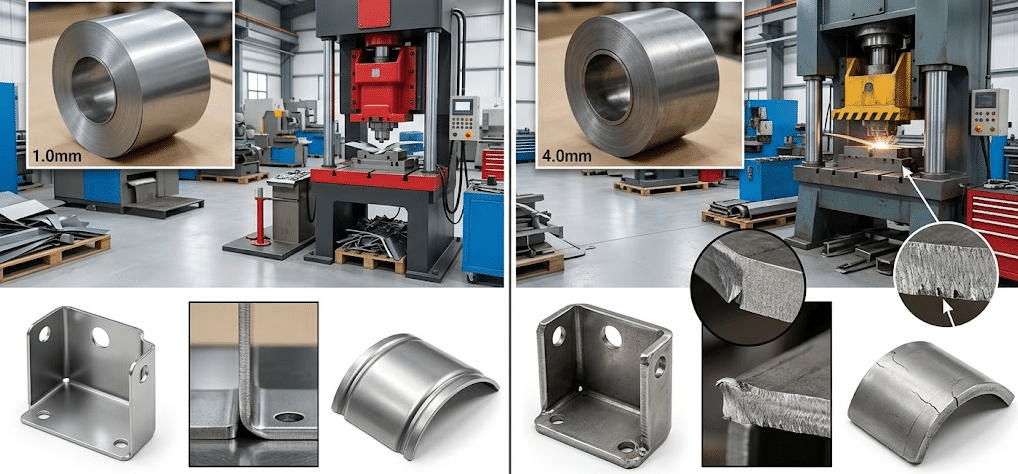
Material thickness strongly affects how sheet metal moves during stamping. Thicker stock can add strength, but it may also demand higher forming forces. It can also push the need for stronger tooling.
In some cases, thin stock bends more easily. But thin does not automatically mean better formability. Very thin sheets can be more prone to wrinkling, local instability, handling marks, and uneven flow of material.
High tensile stress during deep drawing and forming can reduce thickness and trigger cracks. This is often seen near corners, around radii, and in areas that stretch a lot. If the material flow is poor, or compressive stress is too high, wrinkling can show up instead.
Choosing the right thickness means looking at several factors at the same time. Material ductility matters. Blank-holder force matters too. Lubrication plays a role. Punch and die radii affect the result, as does the overall forming ratio. When the shape is hard to make, finite element analysis can be used to estimate thinning, wrinkling, and possible failure before any production run starts.
5. Качество и внешний вид поверхности
Material thickness also changes the surface finishing of штампованная частьs. Thin sheet metal tends to dent more easily. It also shows handling marks. Local distortion happens sooner, and the surface can look wavy. These issues can be tough for decorative panels, enclosures for electronics, and items meant for everyday customers.
Using thicker material often helps. It can resist handling damage better. It can also help keep the final part more rigid. Still, thicker stock may demand higher forming loads. If the tool setup is off, lubrication is weak, or the die face is not in good condition, that can lead to surface defects.
If the part will be painted, plated, polished, or finished in another way, forming strains and surface flaws can carry into the final look. So the choice of material, tool care, and process control all matter. They are needed to keep surface quality stable from one run to the next.
The Relationship Between Material Thickness and Stamping Process Parameters
Material thickness does not operate independently of the stamping process. It directly influences several manufacturing parameters that determine production efficiency and part quality
| Stamping Factor | Effect of Increasing Material Thickness | Производственное рассмотрение |
| Сила штамповки | Generally increases the required cutting and forming force | Select a press with adequate capacity and operating margin |
| Зазор штампа | Requires adjustment to suit the material thickness and properties | Optimize clearance to reduce burrs and cutting defects |
| Износ инструмента | Can increase contact loads and cutting stresses | Use suitable tool materials, coatings, and maintenance schedules |
| радиус изгиба | Often requires a larger minimum bend radius to prevent cracking | Match bend geometry to material ductility and thickness |
| Отпрянуть | May decrease in certain bending conditions | Validate compensation based on material strength and geometry |
| Использование материалов | May increase material consumption per part | Optimize blank layout and part geometry |
| скорость производства | May require adjustments to press speed and process settings | Validate the process under actual production conditions |
| Вес детали | Increases when material area and density remain constant | Balance structural performance against weight requirements |
These relationships are general tendencies rather than universal rules. Actual outcomes depend on the metal grade, thickness range, part geometry, tooling configuration, and stamping method.
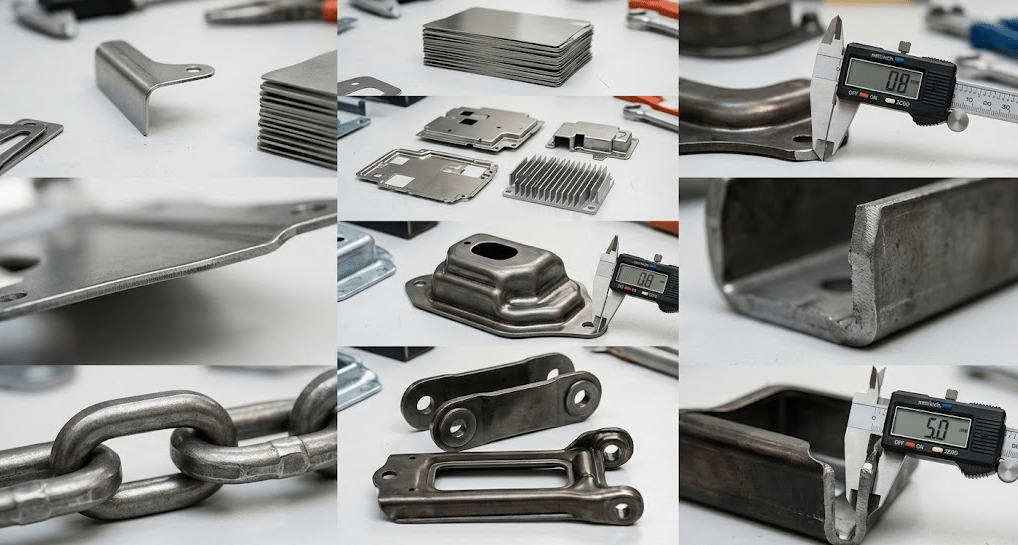
КАК Выбирайте the Right Material Thickness for Stamping Parts
Define the Mechanical Requirements
Start by listing what the part must do. You want to know the real functional needs. These can include tensile load capacity, bending strength, impact resistance, fatigue life, vibration resistance, and how well the part holds its dimensions.
For structural parts, thicker sheet can help with stiffness and long-term durability. For lighter electronic parts, thinner sheet can work if the geometry and the material grade still provide enough strength.
Engineers should judge the actual loading conditions. Choosing thickness only from common practice can miss key issues.
Consider Material Type and Grade
Metals do not behave the same during stamping. Mild steel, stainless steel, aluminum, copper, and high-strength steel each have their own yield strength, ductility, work-hardening behavior, and elastic response.
Например, алюминий can cut down weight. But you still need to pick the alloy carefully and understand forming limits. Stainless steel can resist corrosion and offer strength, yet some grades harden quickly under deformation. High-strength steel can allow thinner parts. Even so, forming behavior and springback can cause extra problems.
Because of this, thickness needs to be checked with the material grade and its mechanical traits.
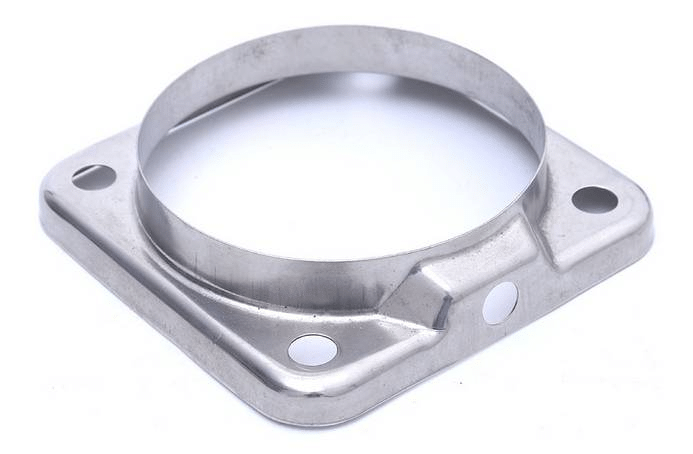
Evaluate Part Geometry and Forming Complexity
Simple bracket supports and flat mounting plates can handle more thickness ranges than parts that rely on sharp bends, thin flanges, or complicated deep-drawn forms.
Tight bend radii, high draw ratios, and small detailed features can raise the chance of cracking, wrinkling, or unwanted thinning. When that happens, moving to a thicker sheet, while keeping the same shape, can make forming harder instead of easier.
Before a final thickness is chosen, the component drawing should be checked. Pay attention to bend radii, draw depth, where holes are located, and the tolerances that must be met.
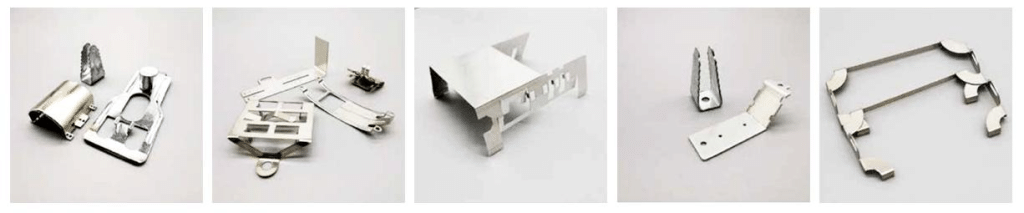
Assess Production Equipment and Tooling
The stamping press, die layout, cutting clearance, feed setup, and the forming steps all need to match the chosen sheet thickness.
If the sheet is thicker than the press can handle, output can slow down and the setup can become unsafe. If the sheet is thinner than the die and tooling were made for, the line can run poorly. Common problems include unstable feeding, bending where it should not bend, burrs, and parts that do not hold their dimensions.
Product design, stamping engineering, and tooling work should be reviewed early together. This can cut down on last minute die changes and lower the chance of repeated trials.
Balance Cost, Weight, and Performance
Material thickness changes both material price and the final part weight. More thickness usually means more steel, more shipping mass, and sometimes more energy during processing.
However, choosing a thickness that is too small can lead to deformation, product failure, higher rejection rates, and costly warranty claims.
The most economical option is not necessarily the thinnest material or the lowest-cost metal. Instead, manufacturers should select the minimum practical thickness that consistently satisfies mechanical, dimensional, safety, and service-life requirements.
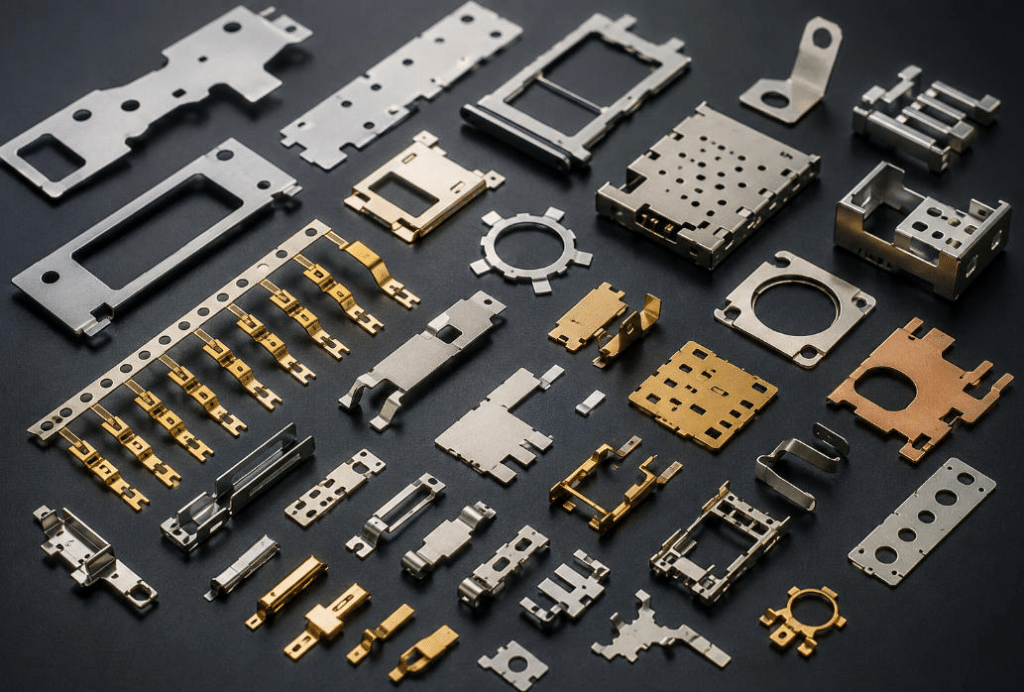
Challenges in Stamping Parts Caused by Incorrect Material Thickness
Incorrect material thickness can lead to manufacturing problems and reduce the reliability of finished stamping parts.
| Вызов | Cause of Incorrect Material Thickness | Влияние на штампованные детали | Возможное Решение |
| Cracking and Fractures | Material is too thick for the required forming geometry or too thin for the applied load. | Part failure, reduced reliability, and increased scrap rates. | Match material thickness to the forming process, bend radius, and load requirements. |
| Размерная неточность | Thickness variation changes bending behavior and material flow. | Inconsistent dimensions and poor assembly fit. | Control incoming material tolerances and optimize die design. |
| Чрезмерное пружинение | Thickness, material strength, and forming geometry are not properly matched. | Incorrect bend angles and shape deviations. | Apply springback compensation and validate tooling parameters. |
| Морщины и коробление | Thin material lacks sufficient stability, or material flow is poorly controlled during forming. | Uneven surfaces, distorted shapes, and rejected parts. | Optimize blank-holder force, die geometry, and forming conditions. |
| Формирование заусенцев | Die clearance is unsuitable for the selected material thickness. | Sharp edges, poor cut quality, and additional finishing requirements. | Adjust punch-to-die clearance and maintain cutting edges. |
| Insufficient Strength and Rigidity | Material thickness is below the component’s structural requirements. | Excessive deformation, reduced load capacity, and premature failure. | Calculate required thickness based on mechanical loads and safety requirements. |
| Excessive Part Weight | Material thickness is greater than necessary for the application. | Heavier products, increased transportation costs, and reduced efficiency. | Optimize component geometry and select an appropriate thickness. |
| Ускоренный износ инструмента | Excessive thickness increases cutting forces and tooling loads. | Shorter die life, higher maintenance costs, and production downtime. | Verify press capacity and use suitable tool materials and clearances. |
| Плохое качество поверхности | Incorrect thickness contributes to deformation, handling damage, or unstable material flow. | Dents, scratches, waviness, and inconsistent appearance. | Optimize thickness selection, lubrication, tooling alignment, and handling procedures. |
| Увеличение производственных затрат | Excessive material use, higher forming forces, and repeated quality defects. | Greater material consumption, energy use, and scrap costs. | Conduct engineering reviews and prototype testing before mass production. |
| Assembly and Fitment Problems | Thickness differences affect formed dimensions, clearances, and mating surfaces. | Misalignment, fastening difficulties, and assembly delays. | Establish suitable thickness tolerances and inspect critical dimensions. |
| Непостоянное качество продукции | Variations in sheet thickness cause changes in forming and cutting conditions. | Unstable product dimensions and inconsistent batch quality. | Implement incoming material inspection and statistical process control. |
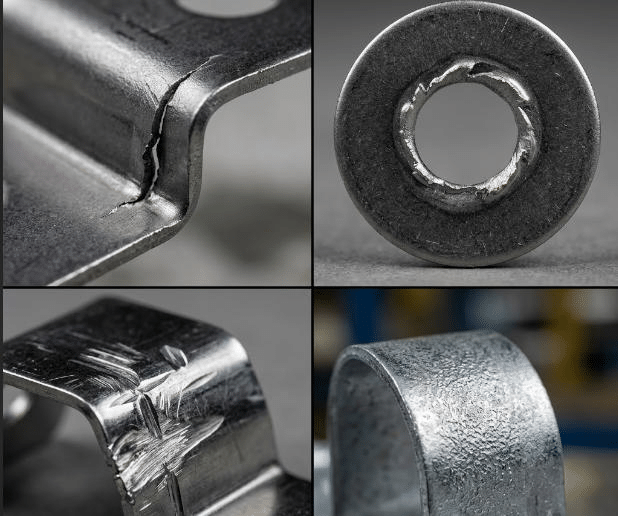
Identifying the root cause is important because not every штамповка дефект can be corrected by changing thickness alone. In many cases, tooling adjustments, material changes, lubrication improvements, or design modifications provide a more effective solution.
Выводы
Material thickness has a significant influence on the strength, rigidity, dimensional accuracy, formability, surface quality, and manufacturing cost of stamping parts. Thicker materials can improve structural performance and resistance to deformation, but they may also increase stamping force, material consumption, and tooling requirements. Thinner materials can reduce weight and cost, yet they may be more susceptible to local instability, dents, and other defects.
To select a proper material thickness, need to consider the material properties, component geometry, operating loads, tooling capabilities, production requirements and quality standards. Engineers can use reviews, forming simulation, prototype runs, and steady quality checks to find a practical balance between performance and cost.
Для компаний, занимающихся поиском поставщиков изготовленные на заказ детали штамповки металла, partnering with a skilled stamping manufacturer can help ensure the material thickness fits the intended use, the planned production volume and long-term reliability.