
Обработка акрила на станках с ЧПУ: руководство по изготовлению прецизионных акриловых деталей на заказ.
Acrylic, also known as PMMA (Polymethyl Methacrylate), is widely used in protective covers, transparent panels, display components, electronic equipment housings, and custom plastic parts due to its high transparency, lightweight properties, weather resistance, and good machinability.
For parts requiring complex contours, precision holes and slots, and high dimensional consistency, Акриловая обработка с ЧПУ can accurately transform CAD designs into finished parts through milling, drilling, slotting, engraving, and other machining processes.
However, acrylic is relatively sensitive to heat, tool condition, and machining parameters. To achieve accurate dimensions, clean edges, and high-quality surfaces, material selection, tooling, cutting parameters, workholding, and post-processing are all critical.
In this post, we will cover the Acrylic CNC Machining process, precision control, surface finishing, cost factors, and supplier selection, helping you develop a more efficient acrylic CNC machining solution.
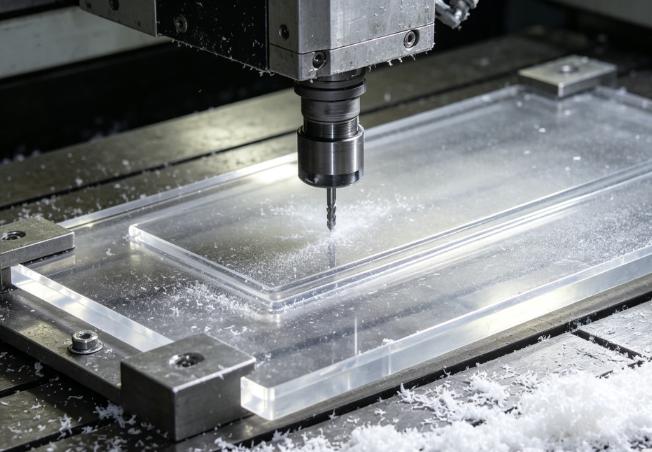
Содержание
Why Is Acrylic Suitable for CNC Machining?
Acrylic is widely used for CNC machining because of its transparency, lightweight properties, machinability, and good weather resistance. For plastic parts that need to combine appearance, functionality, and machining precision, Acrylic is a highly practical material choice.
Высокая прозрачность
Among its significant advantages is high transparency and good light transmission, making it suitable for those parts where you will need to see through the internal structure or light.
These include things such as protective covers, view windows for equipment, display cases, instrument panels, and lighting parts. In case of those products whose optical appearance is critical, transparency, haze, scratch resistance, and edge finish after CNC machining should be considered as well.
Небольшой вес
Compared to glass, acrylic offers a transparent look and is much lighter in weight, making it ideal in instances where the weight of the material is an issue.
This makes acrylic ideal for use in equipment protection, display devices, housing for electronics, and lightweight parts.
Хорошая обрабатываемость
CNC machining of acrylic includes processes such as CNC milling, drilling, slotting, contour machining, and engraving in order to form complex designs with good dimensional accuracy.
Acrylic is, however, susceptible to heat from machining. Poor tooling or incorrect machining parameters lead to melting of the edges, formation of burrs, cracks and even deformation of the material.
Устойчивость к хорошей погоде
Acrylic offers good weather resistance, and certain grades can withstand prolonged exposure to sunlight, rain, and environmental changes. This makes it suitable for outdoor signs, display structures, protective covers, and architectural components.
It is important to note that weather resistance and UV performance vary among different Acrylic grades. For CNC parts intended for long-term outdoor use, the appropriate material grade should be selected based on the actual environment rather than judging performance based solely on the name “Acrylic.”
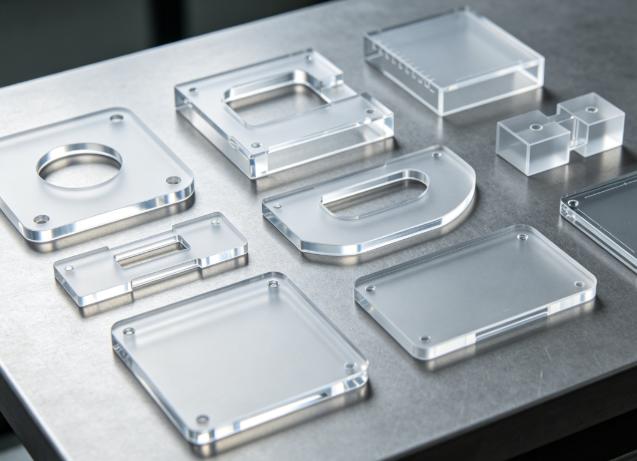
Main Process of Acrylic CNC Machining
A reliable Acrylic CNC Machining project does not begin when the CNC machine starts running. It starts with design, material selection, and engineering evaluation. Each stage can affect the final part’s dimensional accuracy, surface quality, and machining stability.
1. CAD Drawing and Engineering Evaluation
Prior to any machining operations, clients are required to submit 2D drawing information, 3D CAD data, material specifications, dimensional tolerances, order quantity, and surface finish specifications. The engineers analyze the parts to determine their suitability for manufacturing and look at parameters like hole size, wall thickness, inside corners, and access to the tool path.
Sharp corners, for instance, are not common in the design of CNC cutting tools since they tend to be rounded. A review of DFM (Design for CNC Machining) prior to manufacturing is therefore crucial.
2. Acrylic Material Selection
CNC machineable acrylic materials are Cast Acrylic and Extruded Acrylic. Both can be machined using the CNC machine, although they have certain differences in aspects like internal stress, consistency of thickness, machinability, and surface finish capabilities.
Therefore, material selection should not be based on price alone. It should consider the part’s application, machining process, transparency requirements, and final appearance. Material type is particularly important for products requiring high-quality edges or engraving results.
3. CNC Programming and Toolpath
Once the material and manufacturing method have been decided upon, engineers will develop CNC paths for machining using the CAD file and determine the machining sequence, cutting depth, speed, spindle specifications, and tool choice.
For acrylics, a good manufacturing process becomes crucial. Using proper tools and settings may help avoid vibration and heat generation, and facilitate removal of the chips, which will minimize melting, fracturing, burrs, and distortion of dimensions.
4. Закрепление
The acrylic part needs to be properly clamped while machining it. The lack of proper clamping may lead to vibration in the cutting process which will cause dimensional inaccuracy and cracking, scrapping or machining marks on the edges.
In case of machining thin plates, large-size workpieces and complex Acrylic Parts, the work holding technique is chosen depending on the workpiece geometry and direction of machining. The goal is to maintain stability without applying excessive pressure to the material.
5. Обработка с ЧПУ
Depending upon the design of the part, the machining process could include cutting, milling, drilling, slotting, chamfering, and engraving. The machining of complex parts could even necessitate more than one machine or even multiple setups.
Acrylic is a thermoplastic substance, and hence chip removal and cooling need special consideration. Should the cutting heat not be taken away effectively from the acrylic, then the plastic will melt. This is because the plastic material can either melt or become soft.
6. Удаление заусенцев и обработка поверхности
After CNC machining, parts need to be deburred and may require additional surface finishing. For standard industrial parts, removing visible burrs may be sufficient. For transparent Acrylic Parts with higher appearance requirements, additional processes such as edge polishing, surface polishing, or other finishing methods may be required.
Proper post-processing can improve the visual appearance of transparent acrylic while making machined edges smoother and clearer.
7. Размерный и визуальный осмотр
In addition, when the components are completed, they must be inspected for quality, with important aspects being overall dimensions, hole sizes, thicknesses, profiles, flatness, and surface quality. In case of clear acrylic components, the inspection process could involve other aspects like scratch-free, hazed, and transparent edges. With the full inspection process, it will be ensured that Acrylic CNC Machining does not just make a part, but a component that satisfies its real needs.
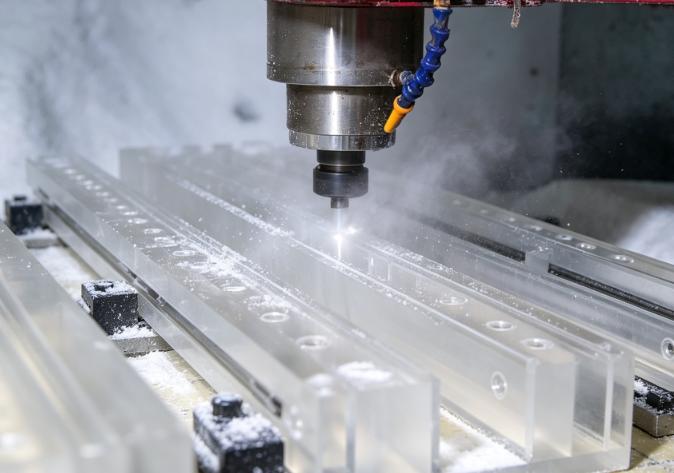
Common Acrylic CNC Machining Processes
Different acrylic parts have different structural and machining requirements, so the appropriate CNC process must be selected accordingly. Common Acrylic CNC Machining processes include milling, CNC engraving, drilling, and CNC routing.
Фрезерование акрила с ЧПУ
Фрезерные is mainly used for acrylic parts with complex three-dimensional structures, such as complex contours, grooves, steps, localized cavities, and features requiring higher dimensional accuracy.
By controlling toolpaths and cutting parameters, CNC milling can produce relatively complex geometries. For equipment guards, mechanical components, and custom Acrylic Parts, CNC Milling is often an important machining method.
CNC Routing Acrylic
CNC Routing is particularly suitable for acrylic sheets requiring 2D or relatively simple contour machining. It can efficiently cut straight lines, curves, and complex outer profiles, making it widely used for sheet processing.
Common products include display panels, advertising signs, equipment panels, protective panels, and custom housings. When a part mainly consists of a flat profile, CNC Routing can provide a good balance between machining efficiency and dimensional consistency.
Акриловое сверление с ЧПУ
Acrylic CNC Drilling is used to produce mounting holes, locating holes, and other functional holes. Compared with manual drilling, CNC drilling provides better control over hole position, diameter, and machining consistency, making it suitable for precision parts and batch production.
However, acrylic can be affected by heat and mechanical stress during drilling. If the tool condition or machining parameters are inappropriate, hole edges may develop cracks, chipping, or localized melting. Therefore, both hole position accuracy and edge quality should be inspected after machining.
Акриловая гравировка с ЧПУ
ЧПУ Гравировка is mainly used to machine text, logos, scales, identification numbers, and other markings onto acrylic surfaces. By controlling engraving depth and toolpaths, clear and precise surface patterns can be produced.
Transparent, black, and other colored Acrylic materials can all be engraved. For brand identification, instrument panels, display products, and custom decorative components, CNC Engraving can provide functional markings while enhancing the visual appearance of the product.
How to Prevent Cracking and Melted Edges in Acrylic CNC Machining?
In Acrylic CNC Machining, cracking and melted edges are relatively common machining problems. They do not necessarily indicate poor material quality. In many cases, they result from the combined effects of machining heat, tool condition, cutting parameters, workholding, and internal material stress.
Контроль температуры обработки
Acrylic is a thermoplastic substance, which means that it is somewhat prone to high temperatures produced by machining. When the cutting tool is simply rubbing against the material, the heat produced will be excessive.
Such high temperatures may lead to the softening of acrylic, melting of its edges, sticking of the material to the tool, and deformation. It is therefore necessary to vary the cutting parameters depending on the material thickness, the tool used, and the performance of the CNC machine.
Use Sharp and Suitable Cutting Tools
Tool condition has a significant impact on Acrylic machining quality. Sharp tools reduce friction and produce cleaner cuts, while worn or unsuitable tools can generate additional heat and increase the risk of edge cracking.
Therefore, machining facilities should select suitable tools based on the acrylic material and specific machining operation and regularly inspect and replace worn tools.
Maintain Effective Chip Evacuation
When acrylic chips get accumulated between the tool and workpiece, they can increase friction, thus making it impossible to dissipate heat efficiently from the machining site.
Hence, Acrylic CNC Machining needs good chip removal and cooling conditions in order to remove chips from the machining site. This will not only reduce melted edges but also improve the finish of the machined surface.
Minimize Machining Vibration
Vibration might cause instability in the process of cutting especially in situations where cutting thin plates, large format panels and small details is done. This might lead to problems such as edge chipping, dimensional inaccuracies and tool marks.
Hence, the selection of the appropriate type of fixturing that would suit the part size and shape should be considered. The machining strategy should also be optimized for minimizing vibration.
Consider Internal Material Stress
Cracking is not always caused entirely by CNC machining parameters. Acrylic may contain internal stress introduced during manufacturing, cutting, or forming. During subsequent machining, this stress may be released and increase the risk of cracking.
For large, thick-walled, complex, or high-reliability Acrylic Parts, the material condition should also be included in the machining evaluation. Only by considering the material, tooling, machining parameters, and workholding together can cracking and melted-edge problems be effectively reduced.
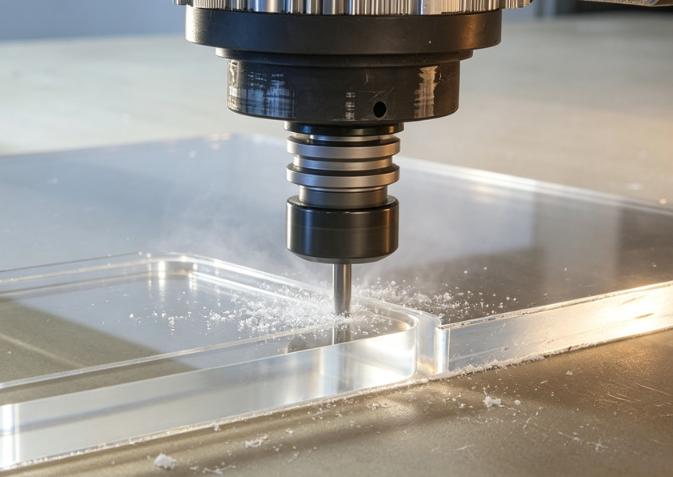
Литой акрил против экструдированного акрила
Before selecting CNC milling for acrylic components, choosing the correct manufacturing type—Cast Acrylic or Extruded Acrylic—can directly affect machining accuracy, production yield, and long-term service performance.
| Коэффициент сравнения | Литой акрил | Экструдированный акрил | Инженерное воздействие |
| Молекулярная структура | Long-chain, highly polymerized structure with high molecular weight | Shorter-chain, oriented structure with lower molecular weight | Affects thermal stability and solvent resistance |
| Обрабатываемость с ЧПУ | Excellent. Produces hard, granular chips and has good resistance to softening | Fair. More prone to sticking, stringing, and melting under high cutting heat | Cast Acrylic generally allows higher spindle speeds and cutting efficiency |
| Internal Stress & Cracking | Low and relatively uniform internal stress | Higher directional residual stress | Extruded Acrylic has a higher risk of stress cracking (craze) after CNC milling or polishing |
| Допуск по толщине | Relatively wider tolerance, typically around ±10% to ±15% | Tighter tolerance, typically within ±5% | Thickness-sensitive assemblies require advance evaluation |
| Optical Performance & Polishing | Good optical isotropy; excellent response to vapor or flame polishing | Annealing is recommended before polishing to reduce cracking risk | Cast Acrylic is generally easier to achieve mirror-like transparency |
| Стоимость и масштабируемость | Higher sheet cost; suitable for customized and higher-end parts | Lower material cost; efficient for high-volume extrusion production | Extruded Acrylic can reduce material costs for high-volume simple structures |
Acrylic CNC Machining vs. Laser Cutting: Key Differences
For acrylic components, CNC machining and laser cutting represent two different manufacturing approaches. The choice should not be based simply on unit price, but on the part geometry, tolerance requirements, and subsequent mechanical or optical functions.
| Фактор оценки | Обработка CNC | Лазерная резка | Лучшее приложение |
| 2D-контуры | Supported, although cutting speed depends on toolpaths | Highly efficient, with fast cutting and no cutting tool wear | Simple flat panels and signs are often better suited to laser cutting |
| 3D Особенности | Fully supported, including blind holes, counterbores, steps, and chamfers | Not suitable; mainly limited to through-cutting | Features involving Z-axis depth changes require CNC |
| Pockets & Blind Holes | Fully supported, with precise depth control | Not suitable; accurately controlling partial-depth laser cutting is difficult | Complex mechanical components should use CNC |
| Cross-Section & Edge Quality | Typically matte or shows machining marks and may require polishing | Smooth, heat-polished edges can provide high visual clarity | Laser cutting is suitable when high transparency of straight outer edges is required |
| Тепловая нагрузка | Mechanical cutting with no concentrated thermal stress | Localized high-temperature melting can create significant internal stress | Laser-cut parts exposed to solvents or adhesives may have a higher risk of stress cracking (craze) |
| Толщина | Highly adaptable; thick sheets can be machined through multiple passes | Limited by laser power; very thick sheets may develop tapered or charred edges | For very thick sheets, CNC is generally preferred |
What Industries Use Acrylic CNC Machining?
Acrylic CNC Machining is especially ideal when working on plastic parts which need to be transparent, lightweight, and specially shaped. Unlike regular acrylic sheet cutting, CNC machining allows the formation of precise holes, grooves, steps, complex shapes, and engraving, making it possible for numerous applications.
Промышленное оборудование
In the manufacturing process, CNC Acrylic Parts find use in machine guarding, viewing windows, control panels, machine covers, and safety barriers.
For instance, a transparent CNC acrylic protective cover could protect moving parts of the machine while still permitting the operator to look inside the machine. In cases where there is need to mount screws and sensors or other components, CNC machining could also manufacture precise mounting holes.
Электроника и приборостроение
Acrylic can be used for transparent equipment housings, display windows, control panels, electronic equipment covers, and custom support components. CNC machining can produce mounting holes, slots, and assembly features based on the actual dimensions of electronic components, making Acrylic Parts easier to integrate with PCBs, displays, connectors, and other components.
For laboratory instruments and testing equipment, transparent housings can also provide a certain level of protection while allowing users to observe internal components or operating conditions.
Display and Retail Equipment
In the display industry, CNC acrylic machining is commonly used for product display stands, POS Displays, brand logos, display boxes, exhibition props, and custom merchandising components.
These products often require not only dimensional accuracy but also high-quality appearance. CNC machining can produce customized contours, mounting holes, and slots, allowing display structures to follow specific brand designs rather than being limited to simple flat cuts.
Lighting and Transparent Structural Components
Acrylic that is either transparent or translucent has high light transmission capability and thus can be employed for housings and other lighting components.
Precision mounting holes and slots can be achieved by CNC machining of the part. But, if the acrylic part has an optical application, then proper selection of the material and the machining process has to be made keeping in mind parameters like light transmission, haze, refraction, etc. Standard transparent Acrylic should not be assumed to meet every optical application.
Laboratory and Equipment Protection
In some laboratories, testing devices, and manufacturing settings, acrylic can be utilized as transparent protective coverings, viewing windows, housing for instruments, and viewing chambers.
CNC Machining permits the production of custom protective parts tailored to equipment size, including the possibility of having mounting holes, ventilation holes, or access holes built into the parts. However, acrylic is not suitable for all chemical, high-temperature, and heavy-load environments. For parts exposed to solvents, corrosive media, or special temperature conditions, chemical compatibility and operating temperature limits should be confirmed before machining.
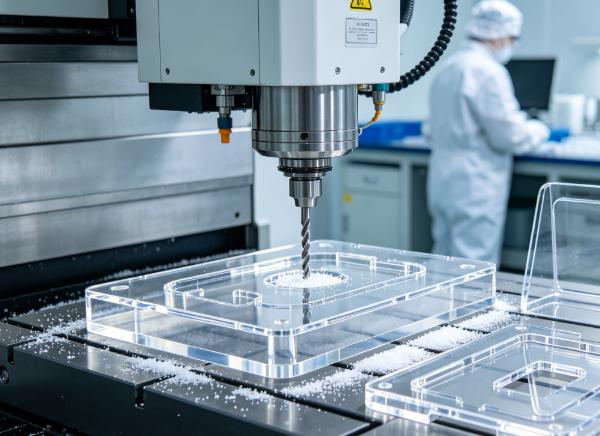
Actual Machining Accuracy and Tolerance Range of Acrylic CNC Machining
For acrylic CNC components, machining tolerances and precision requirements can generally be divided into the following levels:
Standard Commercial Tolerance: ±0.10 mm to ±0.15 mm, suitable for most outer contours, non-assembly slots, and general structural components.
Precision Machining Tolerance: ±0.05 mm, suitable for mating holes, step features, fitting grooves, and microfluidic chip cavities, where strict CAM parameter control and tool management are required.
Extreme Tight Tolerance: ±0.02 mm, applicable only to small localized features, such as high-precision holes with diameters below 20 mm. Maintaining this tolerance consistently requires controlled environmental conditions, typically a temperature-controlled machining area at approximately 20°C ±1°C, combined with stress-relief or annealing processes where appropriate.
How to Choose a Reliable Acrylic CNC Machining Supplier?
When selecting an Acrylic CNC Machining Supplier, price should not be the only consideration. Acrylic is sensitive to heat, tool condition, machining parameters, and internal material stress, so a supplier’s engineering capabilities and quality control are equally important.
Evaluate CNC Machining Capabilities and Experience
Check whether the supplier has CNC milling, CNC routing, drilling, and engraving services. Most importantly, check whether the supplier has machining experience on acrylic / PMMA for a considerable number of years.
Machining experience enables the manufacturer to choose suitable machining tools and machining process parameters based on the thickness of the material and part geometry.
Evaluate Engineering and DFM Capabilities
A professional supplier should do more than simply manufacture according to the drawing. They should also be able to identify potential manufacturing problems before production begins.
For example, they should evaluate whether wall thickness, hole diameter, internal radii, deep slots, and workholding methods are suitable for CNC machining. Strong DFM (Design for Manufacturing) capabilities can help customers optimize designs in advance, reducing rework and production costs.
Оценить контроль качества
A reliable supplier should have a complete dimensional and visual inspection process. Based on the accuracy required, the inspection equipment used can be calipers, micrometers, height gauges, CMMs, or optical inspection equipment.
When inspecting Acrylic Parts that are clear, care should also be taken of scratches, chipping, melted edges, haze, and edge quality. For parts that need to be assembled, the holes’ positions should be noted.
Evaluate Prototyping and Mass Production Capabilities
In case of a new product development, it is suggested that we first create the Prototype in order to confirm the dimensions, assembly, appearance, and functionality before proceeding with mass production.
A good supplier should be able to cater to all phases, from Prototype → Small Batch → Mass Production, without compromising on any dimensional stability and appearance.
Compare Suppliers Based on Overall Value, Not Just Price
The lowest quotation does not necessarily represent the lowest overall cost. Material specifications, machining tolerances, prototype costs, lead times, inspection standards, and batch-to-batch consistency can all affect the final purchasing cost.
Therefore, when selecting an Acrylic CNC Machining Supplier, buyers should evaluate machining capabilities, engineering support, quality control, and delivery capabilities rather than focusing solely on unit price.
KENENG CNC Service for Acrylic CNC Machining
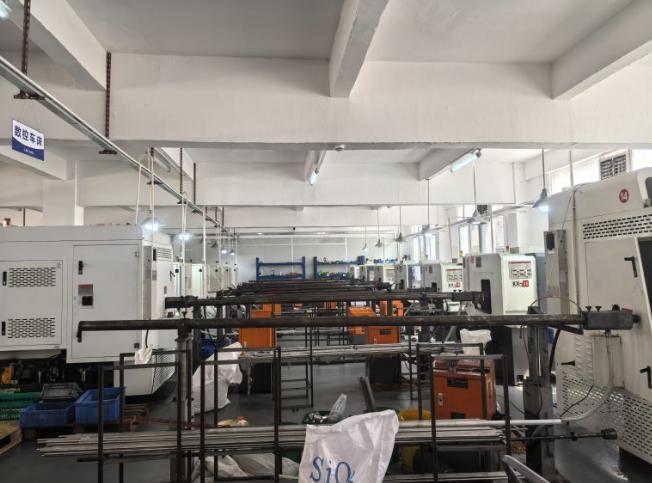
КЕНЕНГ provides Acrylic CNC Machining Services from prototyping to mass production. With a 3,000 m² workshop, 60+ skilled employees, and 16 CNC machines, KENENG supports CNC Milling, Turning, Drilling, Tapping, EDM, and Wire EDM.
Precision Machining and Engineering Support
KENENG offers 3-axis, 4-axis, and 5-axis CNC machining capabilities, with standard tolerances up to ±0.005″ (±0.127 mm) and tight tolerances down to ±0.0005″ (±0.0127 mm), depending on part design and machining requirements.
KENENG also provides DFM design reviews and uses CMMs and optical comparators for dimensional inspection, supporting Acrylic prototypes, small-batch production, and volume manufacturing.
Looking for a reliable Acrylic CNC Machining Supplier? Contact KENENG для цитаты.