
Metals for Large CNC Machined Parts
In large-scale CNC machining projects, equipment performance is undoubtedly important, but one of the key factors that truly determines part quality, machining cost, and service life is material selection.
Whether in oil and gas equipment, engineering machinery, mining equipment, wind power equipment, or aerospace structural components, different metal materials directly affect machining efficiency, dimensional stability, corrosion resistance, and final manufacturing costs.
If you are looking for the metals for large CNC machined parts, this guide details the most commonly used materials in industry today and helps you make the right choice based on your project requirements.
Table of Contents
Why Large-scale CNC Machining Requires Greater Focus on Material Selection
Compared to conventional precision parts, large-scale CNC machined parts have fundamentally different physical characteristics and manufacturing processes. They typically feature:
- Long machining cycles: Individual parts often require continuous milling for ten or even dozens of hours.
- High material removal rates: Large volumes of excess metal must be cut away from bulky raw blanks.
- Significant thermal accumulation: Massive amounts of heat generated during prolonged cutting easily lead to thermal deformation.
- Severe internal stress release: As excess material is removed, residual stresses inside the blank can easily break equilibrium.
- Complex fixturing and positioning: Extremely high demands are placed on machine table load capacity and fixture design.
- High trial-and-error costs: Raw materials and machining labor value are immense; once scrapped, losses are catastrophic.
Because of this, material selection not only directly determines the final mechanical performance of the product, but also dictates whether the entire machining process can proceed smoothly.
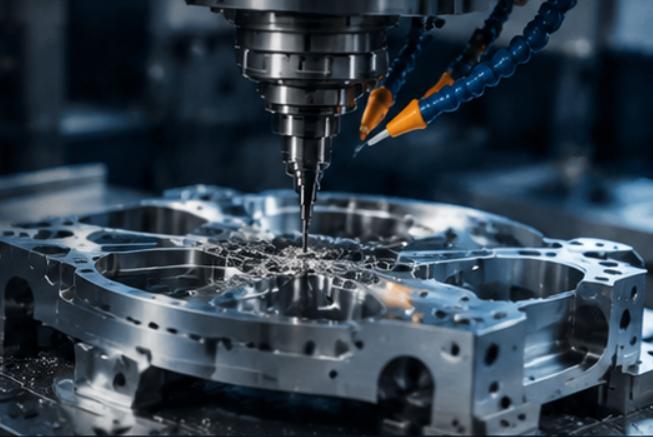
Engineering Case Warning: Taking a 3-meter-long steel structural component from earlier machining stages as an example, if internal residual stresses suddenly release during continuous cutting over a dozen hours, it can easily cause irreversible warping or dimensional shifting of the part. This directly leads to component scrapping and massive losses in time and economics.
In contrast, if raw blanks with good stress stability and outstanding anti-deformation capabilities (such as stress-relieved plates or high-quality forgings) are prioritized during the material selection stage, machining risks can be significantly reduced at the source, ensuring dimensional tolerances are flawless.
Comparison of Common Metal Materials for Large CNC Machining
In industrial manufacturing, different materials for CNC machining parts vary significantly in mechanical performance, processing costs, and application scenarios. There is no absolute “best”, only the most suitable material for specific working conditions. Below is a core performance comparison of the most common metal materials used in large CNC machining:
| Material Type | Strength | Machinability | Corrosion Resistance | Raw Material Cost | Core Applicable Industries |
| Aluminum 6061 | ★★★☆☆ | ★★★★★ | ★★★☆☆ | Low | Automation, General Machinery |
| Aluminum 7075 | ★★★★★ | ★★★★☆ | ★★★☆☆ | Medium | Aerospace, Military Defense |
| Carbon Steel | ★★★☆☆ | ★★★★☆ | ★★☆☆☆ | Low | Engineering Machinery, Heavy Bases |
| Alloy Steel | ★★★★★ | ★★★☆☆ | ★★☆☆☆ | Medium | Oil & Gas, Heavy-Duty Equipment |
| Stainless Steel 304 | ★★★★☆ | ★★☆☆☆ | ★★★★☆ | Medium-High | Food Machinery, Medical Equipment |
| Stainless Steel 316 | ★★★★☆ | ★★☆☆☆ | ★★★★★ | High | Marine Engineering, Chemical Equipment |
| Titanium | ★★★★★ | ★☆☆☆☆ | ★★★★★ | Very High | Advanced Aerospace, Deep-Sea Equipment |
| Brass | ★★☆☆☆ | ★★★★★ | ★★★★☆ | Medium | Electrical Equipment, Hardware Fittings |
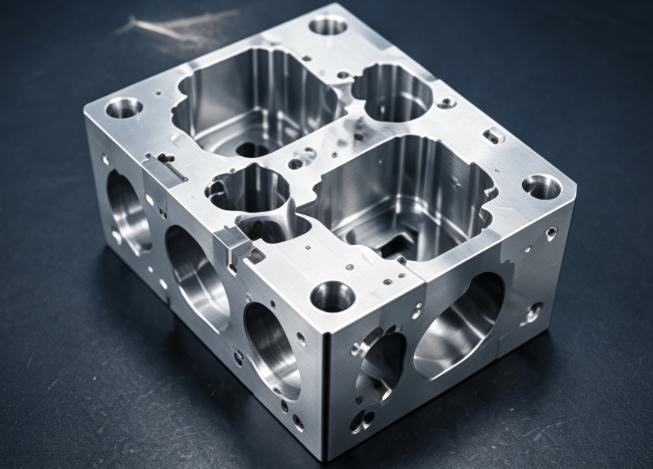
1. Aluminum: The Top Choice for Lightweight Large CNC Machined Parts
The use of aluminum is quite common in large CNC machining parts, owing to the ability of aluminum to offer the best combination of weight, strength, and efficiency. It is therefore used in automation systems and robots.
Core Advantages
Exceptional strength-to-weight ratio: Helps in reducing the weight of the component without sacrificing its strength, thus is suitable for use in mechanical structures where weight needs to be reduced.
High machinability: Offers less cutting force and hence high cutting speed and low tool wear, thus helps in reducing manufacturing time and cost of processing.
Dimensional stability: Has slight deformation after being heat treated, thus makes it more suitable for manufacturing large precision components.
Excellent post-processing properties: Provides good surface finish, thus helps it undergo anodizing, sandblasting, and coating.
Common Grades
6061-T6: Comprehensive performance is excellent; suitable for automation equipment, industrial frames, and general mechanical parts.
7075-T6: Strength approaches that of some alloy steels; better suited for aerospace, high-end equipment, and high-load structural components.
Typical Applications: Automation equipment bases, robotic structural components, drone parts, aerospace brackets, precision mechanical frames.
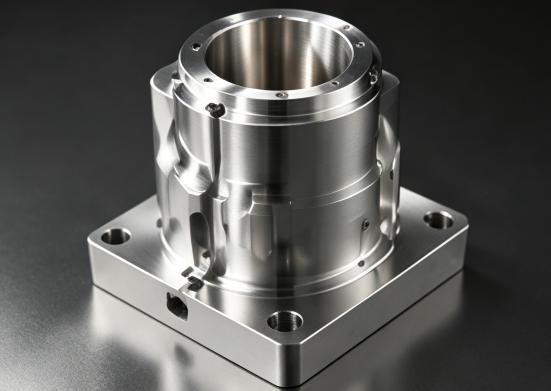
2. Carbon Steel: The Most Cost-Effective Material for Large Structural Components
For large equipment manufacturing projects pursuing high strength and cost control, carbon steel remains one of the most economical and mature metal materials. Backed by stable mechanical properties and a broad supply chain, it is widely used in heavy machinery and large welded structures.
Core Advantages
Significant cost advantage: Low raw material prices and easy procurement, making it suitable for high-volume production.
Stable mechanical performance: Features good tensile strength, rigidity, and weldability to meet the needs of most industrial structural parts.
High machining efficiency: Excellent cutting performance, particularly suited for roughing large parts and high material removal rates.
Easy subsequent manufacturing: Can be conveniently welded, heat-treated, and machined, making it suitable for complex structural part production.
Usage Recommendation
However, carbon steel exhibits poor corrosion resistance characteristics; nonetheless, after undergoing the processes of painting, galvanization, electroplating, or powder coating, it becomes suitable for most industrial uses.
Applications: Engineering machinery, lifting machinery, large machinery bases, mining machinery, heavy steel structures.
3. Alloy Steel: The Best Material for Heavy Industry Machinery
In cases where the parts have to withstand heavy loads, high pressure, impact load, or fatigue, alloy steel is usually preferred to carbon steel due to the significant improvement in mechanical properties achieved through heat treatment.
Grades: AISI 4140, AISI 4340, 42CrMo.
Core Advantages
Combines high strength and high toughness: Suitable for high-load and complex working conditions.
Outstanding fatigue resistance: Can withstand cyclic loads over long periods without failure after quenching and tempering treatment.
Prominent wear resistance: Suitable for frequent friction or impact conditions, extending part service life.
Excellent heat-treatment performance: Capable of achieving various mechanical properties tailored to different application requirements.
Machining Characteristics
Compared to ordinary carbon steel, alloy steel has higher hardness and causes greater tool wear, thus typically requiring more reasonable cutting parameters and high-rigidity processing equipment.
Typical Applications: Oil and gas equipment, hydraulic systems, heavy machinery, mining equipment, wind power equipment, large shafts, flanges, and high-strength fasteners.
4. Stainless Steel: Best for Extreme Corrosion Conditions
When it comes to large-size parts with long-term operations in moist, salt spray, chemical medium or marine conditions, stainless steel has high corrosion resistance and durability. It is extensively used in food industry, chemical, marine and energy sectors.
Grade
Stainless Steel 304: High resistance to corrosion, especially from all forms of corrosion, and good machinability; popular in food machinery, medical appliances, and general industrial applications.
Stainless Steel 316: Presence of molybdenum (Mo) gives it high resistance to corrosion from chlorides compared to 304, and therefore suitable for use in marine engineering, LNG, sea water applications, and chemicals.
Core Advantages
- Superior corrosion resistance
- Good high-temperature performance
- Long service life
- Low later-stage maintenance costs
- Excellent appearance quality
Machining Characteristics
Stainless steel has lower thermal conductivity and is prone to work hardening, placing higher demands on machine rigidity, cutting parameters, and cutting tool materials during processing. However, from a long-term operational perspective, its corrosion-resistance advantages typically lower equipment maintenance and replacement costs effectively.
5. Titanium: High-End Material for High-Performance Large Parts
Titanium alloys possess an extremely high strength-to-weight ratio alongside outstanding corrosion resistance and high-temperature resistance, making them essential materials for aerospace, high-end equipment manufacturing, and deep-sea engineering.
Core Advantages
High strength and light weight: Significantly reduces overall equipment weight while maintaining high mechanical strength.
Exceptional corrosion resistance: Long-term resistance against seawater, acid/alkali media, and harsh environmental corrosion.
Superior high-temperature performance: Suitable for special working conditions involving high temperatures and pressures.
Good biocompatibility: Widely used in medical implants and high-end medical equipment.
Machining Characteristics
Titanium alloys feature poor thermal conductivity, easily generating high heat during cutting which accelerates tool wear. Additionally, the material has a strong tendency to stick to tools, making its machining difficulty visibly higher than that of steel and aluminum. It places high demands on equipment performance, tooling, and machining expertise.
Typical Applications: Aerospace structural components, national defense and military equipment, deep-sea exploration equipment, marine engineering, medical implants, high-end energy equipment.
Impact of Different Metal Materials on CNC Machining Efficiency
Materials affect not only part performance, but also direct manufacturing costs.
| Metal Material Type | Cutting Machining Efficiency | Spindle Speed / Feed Rate | Tool Wear & Cost | Core Constraint Factors |
| Aluminum | ★★★★★ (Very High) | Very High (Supports large-feed high-speed cutting) | Low (Long tool life) | Chip evacuation & high-speed dynamic balancing |
| Carbon Steel | ★★★★☆ (Relatively High) | Higher (Balances efficiency and rigidity) | Medium (Conventional wear) | Roughing heat dissipation & chip disposal |
| Alloy Steel | ★★★☆☆ (Medium) | Medium (Requires appropriately lower cutting speeds) | Higher (High hardness accelerates wear) | High cutting resistance & internal stress release |
| Stainless Steel | ★★☆☆☆ (Relatively Low) | Lower (Strictly prevent work hardening) | High (Prone to built-up edges and chipping) | Poor thermal conductivity & strong work-hardening tendency |
| Titanium | ★☆☆☆☆ (Very Low) | Very Conservative (Low speed, small depth of cut) | Extremely High (Prone to burning and frequent tool changes) | Extremely poor thermal conductivity & cutting heat concentrated at tool tip |
How to Select Suitable Metals for Large CNC Machined Parts
When purchasing large CNC machined parts, materials affect not only machining efficiency, but also part strength, precision, durability, and manufacturing costs. Key aspects recommended for focus during selection include:
Part Size
With an increase in the size of the component, it becomes more vulnerable to internal stresses and heat distortions. It is better to select stable materials, for example, stress-relieved or aged aluminum alloys, as well as alloy steels, in order to provide high machining accuracy and stability.
Strength Requirements
The selection of material is dependent upon load requirements for the part. For heavy-loaded components or those that have to sustain heavy impacts, alloy steel or high-strength aluminum alloy should be chosen; other general-purpose parts can use cheaper materials such as carbon steel.
Working Environment
When the components are exposed to humidity, marine, or chemical surroundings, then 304 or 316 stainless steel having corrosion resistant capability should be selected. From among both, 316 stainless steel exhibits greater corrosion resistant characteristics and can be selected for tougher conditions.
Weight Requirements
In cases where there is an emphasis on weight reduction like aerospace and automation industry applications, aluminum alloy should be considered for its lightweight characteristics; for increased strength and corrosion resistance, titanium alloy can be selected.
Cost Budget
The selection of materials should be based on performance and cost. In the case where cost is low, then carbon steel will be preferred, while in the case where lifetime is more important than cost, alloy steel or stainless steel will be more economical.
How to Select a Good Supplier for CNC Machining Service?
In most cases, large-scale CNC machining services have high blank costs, machining time and require tolerances. This means that it is necessary to select a supplier that has real hard capabilities.
When screening and evaluating large CNC machining service providers, it is recommended to focus on five key dimensions:
Large Heavy-Duty Machine Tools & Hardware Configuration
The premise of machining large parts is having the right tools. Conventional small machining centers cannot support large workpieces.
Does the supplier own long-travel Gantry Milling Machines, Floor Boring & Milling Machines, and heavy-duty CNC lathes?
What are the table load capacities (tonnage), effective XYZ-axis travels, spindle rigidity, and do they feature pallet changers or on-machine measurement systems?
Stress Control & Heat Treatment Capabilities
Large metal plates or forgings are prone to deformation after removing massive allowances; suppliers must possess a mature process control chain.
Does the supplier possess mature Stress Relief Annealing process support, or do they have long-term cooperative, standardized external heat-treatment supply chains?
Excellent suppliers know how to scientifically plan operations between “roughing” and “finishing,” actively releasing internal stresses rather than completing everything in one go, which leads to final scrapping.
Large High-Precision Inspection Capabilities
“Can be manufactured” does not equal “can be measured.” Form and position tolerances, flatness, and coaxiality inspection of large parts require specialized metrology equipment.
Are high-precision Coordinate Measuring Machines (CMM), large Laser Trackers, or other inspection instruments equipped on-site?
Can complete Inspection Reports and Mill Test Certificates be provided?
Project Experience & Engineering Team
The clamping, alignment, and tool path programming of large parts heavily rely on experience. A slight misstep can not only damage the workpiece, but also cause collisions.
Has the supplier handled similar large part cases in heavy machinery, aerospace, automation lines, or energy equipment in the past?
Can an exceptional engineering team proactively point out design risks in drawings during the quotation stage and offer Design for Manufacturability (DFM) optimization suggestions to help clients lower overall costs?
Supply Chain Synergy & Logistics Guarantee
The procurement of big-sized blanks (such as big aluminum blanks, long alloy steel forgings), and surface treatments (such as big anodization, heat treatment, heavy-duty corrosion protection) frequently involve coordination among multiple parties.
Does the supplier have one-stop-service capability, and does he/she have the competence to handle all the processes from blank manufacturing, mechanical machining, surface treatment, to packing and transportation?
Conclusion
In large-scale CNC machining projects, material selection is not only related to the part performance, but can directly affect machining efficiency, manufacturing costs, and reliability.
Aluminum alloy is ideal for lightweight application, while carbon steel provides excellent cost-performance; alloy steel suits high-load conditions; stainless steel is suitable for demanding corrosion resistance; and titanium alloy is mainly used for high-end applications such as aerospace industry.
In practice, when selecting a metal material, it is suggested to take into consideration part dimensions, mechanical performance, operating environment, machining difficulties, and budget constraints. Meanwhile, partnering with a manufacturer rich in large CNC machining experience, such as KENENG, can also help you obtain higher quality, more stable, and more cost-competitive solutions.