
Who Offers Custom Metal Stamping Services for Small Parts
In industries such as electronics, automotive, medical, telecommunications, and industrial equipment, small metal stamping parts are virtually ubiquitous. From tiny connecting plates and springs to precision terminals and shielding cans, these components all rely on high-precision metal stamping processes.
So, who offers custom metal stamping services for small parts? While the market is flooded with suppliers, manufacturers vary significantly in tool design, machining precision, material selection, production capacity, and quality control.
If you are looking for a dependable metal stamping manufacturer, this article will guide you through the process of selecting a professional supplier and highlight the essential capabilities an outstanding manufacturer should possess.
Table of Contents
What Are Small Custom Metal Stamping Parts?
Small custom metal stamping parts are precision hardware components produced by applying external force to metal coils or sheets using high-precision punch presses and specialized precision dies. The effect leads to a separation or plastic deformation of the material into the desired geometry, size, and physical characteristics.
Due to the extreme efficiency of manufacturing using stamping process, its remarkable ability to deliver great dimensional accuracy and huge economy-of-scale effect which reduces cost per piece manufactured, stamping process has become the backbone of efficient manufacturing of small metal components.
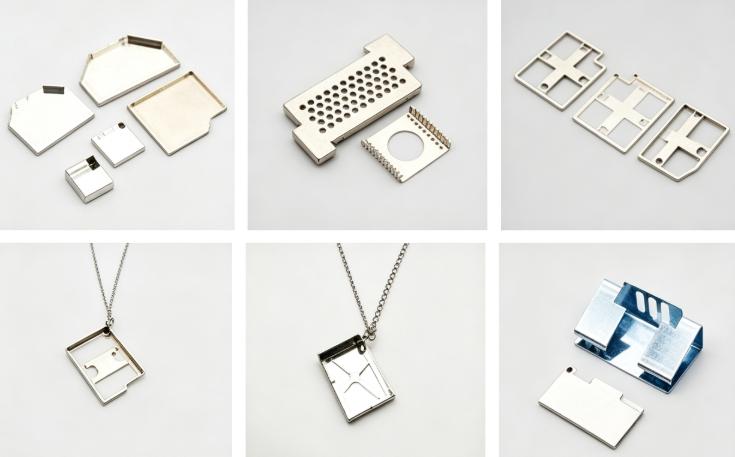
Common High-Frequency Applications Include:
Electronic & Electrical Components: Precision terminals for connectors, contacts for batteries, EMI/RFI shielding cans, and switch contacts.
Precision Fasteners & Structure: High elasticity metal clips, precision washers, micro brackets, and precision housings for sensors.
High-Standard Industry Components: Automotive-grade metal clips, miniature medical device components, and precision hardware for drones and robotics.
Technical Challenge: Due to their miniature size, these parts typically demand micron-level geometric tolerances and strict burr control. This places exceptionally high requirements on the manufacturer’s tool grinding precision and stamping stability.
Who Offers Small Metal Stamping Customization Services?
On the supply chain side, vendors capable of providing small metal stamping services generally fall into three categories. Understanding their positioning helps you target the best fit for your specific project phase:
1. Precision Metal Stamping Manufacturers
This is the most recommended choice for long-term strategic partnerships. These manufacturers focus deeply on the stamping field and typically possess a complete closed-loop workflow, from high-speed presses and in-house progressive die R&D to automated production lines.
Core Advantages: Proficient in complex progressive die stamping, high-speed stamping, and micro-stamping; strict tolerance control; ideal for long-term, high-volume stable supply.
2. One-Stop OEM Metal Parts Manufacturers
The manufacturing scope of these companies extends beyond stamping, horizontally integrating multiple metalworking processes.
Core Advantages: In addition to stamping, they simultaneously provide CNC precision machining, laser cutting, CNC bending, welding, surface finishing, and sub-assembly. If your final product is a complex assembly requiring multiple processes, a one-stop OEM supplier drastically simplifies your supply chain management (Single-Source Advantage).
3. Tooling Manufacturers
The mold/die is the “heart” of stamping. Some manufacturers lead with tool R&D and complement it with trial runs and contract stamping services.
Core Advantages: Expert at overcoming highly complex tool designs with numerous bending stages (e.g., complex progressive dies, compound dies, and stage dies). They can mitigate product design defects right from the source through Design for Manufacturability (DFM), making them excellent partners during the New Product Introduction (NPI) phase.
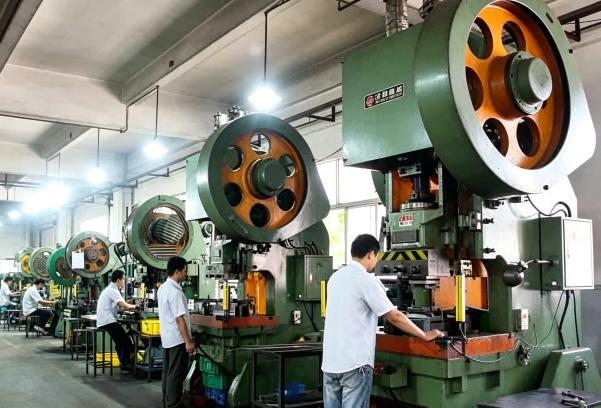
Core Manufacturing Capabilities to Evaluate in a Metal Stamping Supplier
Evaluating whether a stamping supplier truly possesses small-part processing capabilities goes beyond looking at their factory footprint. You should focus your audit on the following five core indicators:
| Capability Dimension | What It Implies | Why It Is Critical for Small Precision Parts |
| In-House Tool Design | Possessing an independent engineering team utilizing UG and AutoCAD for DFM analysis and design, along with in-house tool making and spare parts machining. | Small stamping dies are highly susceptible to wear. Having in-house maintenance capabilities means tools can be repaired within hours when damaged, avoiding downtime risks. |
| Progressive Die Stamping | The ability to design and run high-speed, multi-station progressive dies that complete blanking, bending, drawing, and other processes within a single strip-fed tool. | This is the key to reducing the per-part cost of small components. An excellent progressive die enables fully automated, high-speed production, ensuring zero batch-to-batch variation across millions of parts. |
| Precision Tolerance | Precision Tolerance Factories that are installed with precision wire EDM and high accuracy grinding machines, which make the critical dimension of the stamped products possible to be maintained steadily with a tolerance of ±0.01 mm. | Any small error in electronic and medical devices will lead to failure of the whole batch; thus, micron control is the standard of quality. |
| Surface Finishing & Secondary Operations | Perfect combination of precision deburring (vibration and chemical polishing), ultrasonic degreasing, selective or overall plating (gold, silver, nickel, tin) and heat treatment. | Small parts require extremely clean and conductive surfaces. One-stop-shop processing avoids the possibility of parts being deformed, oxidized or re-contaminated when being moved around the plants. |
| Quality Inspection & ISO Certification | Factory is certified with ISO 9001:2015 (for automotive projects – IATF 16949). Factory has 2.5 D optical measurement equipment, CMMs, precision hardness testers, etc. | Possibility of standardized FAI reports, PPAP documentation and RoHS/REACH materials certifications provides complete process traceability. |
Common Materials and Selection of Metal Stamping
Different metal materials vary drastically in ductility, conductivity, hardness, and springback rate. Below are the materials used for small stamped parts:
Stainless Steel (304, 316, 301, 430): Offers high mechanical strength, excellent corrosion resistance, and high-temperature performance.
Applications: Frequently used for high-performance micro-springs, clips, medical device accessories, and precision protective enclosures.
Carbon Steel (Low Carbon Steel / Cold Rolled Steel like SPCC): Features excellent machinability, high structural strength, and highly competitive material costs.
Applications: Widely used for internal structural brackets, general hardware accessories, and automotive retaining clips (usually requiring post-plating for rust prevention).
Aluminum Alloys (5052, 6061, 7075): Low density (lightweight), non-magnetic, corrosion-resistant, with good thermal conductivity and dissipation.
Applications: Consumer electronics housings, telecommunications shielding cans, and lightweight components for new energy vehicles.
Brass & Copper: Copper provides exceptionally high electrical and thermal conductivity; brass retains good conductivity while offering higher hardness and machinability.
Applications: Power connectors, wiring terminals, battery contacts, and electrical switch contacts.
Phosphor Bronze & Nickel Silver: Phosphor Bronze boasts outstanding fatigue resistance and elastic deformation recovery; Nickel Silver is frequently used in electronic environments requiring direct welding and anti-magnetic properties.
Applications: High-frequency insertion connector springs, micro-relay reeds, and miniature high-elasticity structural parts.
Selection Tip Regarding Material: Engage the engineers from the stamping manufacturing company right from the design process stage. For example, where there is a need for very tight bending angles and high elastic material, use phosphor bronze rather than ordinary brass to avoid micro-cracks along the bends. When it comes to stainless steel, type 301 is quicker to harden than type 304.
The Complete Manufacturing Process for Small Metal Stamping
Any mature custom stamping process will strictly adhere to the following 10-step procedure, which takes the design from drawing board to perfect completion:
Step 1: Submission of Design: The customer submits basic 2D/3D drawings such as STEP, IGS or DWG format drawings, or actual samples, along with tolerances required, materials and expected annual unit volume (EAU).
Step 2: DFM Analysis: Engineering department analyzes these drawings, looking at bend radius and spacing of holes to fine tune the process, and avoid tearing or spring back of material while manufacturing.
Step 3: Tool & Die Design: Utilizing advanced 3D software to create the strip layout. For small components, this is typically designed as a multi-station progressive die to ensure highly efficient forming as the strip is fed through.
Step 4: Die Manufacturing: Tool components are machined in the in-house tool room using wire EDM, precision grinders, and CNC machining centers. Punches and dies are often made from tungsten carbide or high-grade tool steel to guarantee a tool life of millions of strokes.
Step 5: Sample Prototyping: Once the die is assembled, the first tool trial (T1) is performed. Initial samples are produced on the press to verify tool action and smooth strip layout progression.
Step 6: Sample Approval: The Quality Control (QC) department conducts full-dimensional measurements on the trial samples and issues an FAI (First Article Inspection) report. Samples and reports are sent to the customer for fit-and-function assembly testing and formal sign-off.
Step 7: Mass Production: Production begins upon approval. Metal coils are fed into automatic straightener-feeders, and high-speed precision presses run fully automated stamping at dozens or even hundreds of strokes per minute. QC inspectors conduct on-line SPC auditing to monitor dimensional drift.
Step 8: Secondary Operations and Surface Finishes: Parts made through stamping undergo processes such as vibratory tumbling, thermal deburring, and chemical polishing to eliminate micro-burrs from their edges. They are then cleaned to remove oil residues and undergo either selective or general plating using gold, silver, nickel, zinc, and other materials.
Step 9: Quality Inspection: Finished parts undergo a final inspection phase. Automatic 2.5D optical measuring systems are used for batch measurements of critical dimensions. Salt spray testing, hardness testing, or solderability testing are performed as needed to ensure complete compliance with factory standards.
Step 10: Packaging and logistics: Precision parts are susceptible to deformation when subjected to external force. We offer you either taped or reeled packaging, tray packing, or moisture-proof vacuum-packed bags. After labeling, we ensure their transportation through sea, air, or express shipping methods.
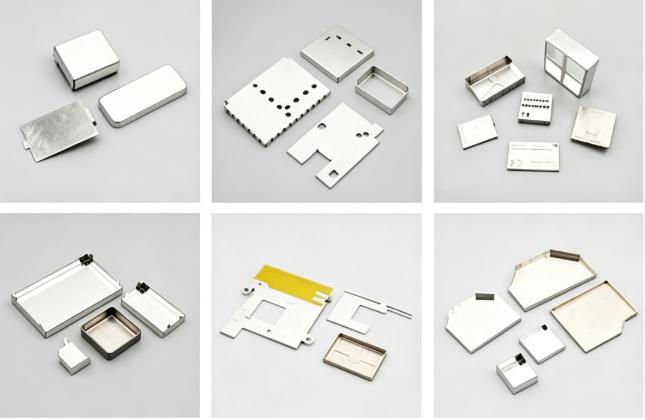
Key Industries Relying on Precision Miniature Stamping
As modern industrial products trend toward being “thinner, lighter, shorter, and smaller” alongside increased intelligence, the breadth and depth of micro-stamping applications continue to surge:
Automotive & EV: Battery Management System (BMS) busbars, high-voltage connectors, automotive sensor springs, and airbag deployment hardware.
Medical Devices: Precision micro-accessories for surgical instruments, micro-rigid parts for endoscopes, and sealed housings for implantable devices.
Consumer Electronics & Smart Hardware: Smartphone Type-C interfaces, TWS earbud charging contacts, and micro-spring clips.
Telecommunications: Optical module shielding cans, micro-base station antenna vibrators, and RF connector hardware.
Industrial Automation & Robotics: Miniature relays, smart servo motor encoder springs, and automation control terminal connectors.
Aerospace & Drones: Lightweight micro-mounts and highly reliable electrical contacts for navigation systems.
Why Global Enterprises Choose Chinese Metal Stamping Manufacturers
In recent years, China’s precision hardware manufacturing has completed its transformation from “extensive processing” to “high-precision smart manufacturing.” Large numbers of Western and global buyers look to Chinese OEM stamping factories for several core reasons:
Unmatched Comprehensive Cost Advantages:
Leveraging China’s highly mature industrial raw material supply chain and efficient logistics network, companies can secure highly cost-effective quotes.
Deep Tooling Expertise:
Engineering teams at many mature Chinese factories possess over a decade of experience in precision progressive die R&D. Complex tool development cycles typically take only 15 to 30 days, offering turnaround speeds that outpace local options overseas.
Flexible MOQs:
Compared to Western giants that often impose thresholds of hundreds of thousands of pieces, Chinese manufacturers are more willing to support customers’ NPI stages by accommodating low-volume high-mix production to lower early-stage trial risks.
Rich One-Stop Support & Export Experience:
Most export-oriented stamping plants are well-versed in Western industrial standards, capable of providing full technical communication in English and complete quality documentation (such as FAI, PPAP, and material certs), backed by mature cross-border logistics and customs clearance systems.
Why Choose KENENG as Your Small Metal Stamping Partner?
As a leading global precision hardware manufacturer, KENENG specializes in providing high-quality, high-consistency custom metal stamping solutions for small parts to clients worldwide. Backed by over a decade of cross-border delivery experience and top-tier processing equipment, we serve as your comprehensive engineering and technical partner.
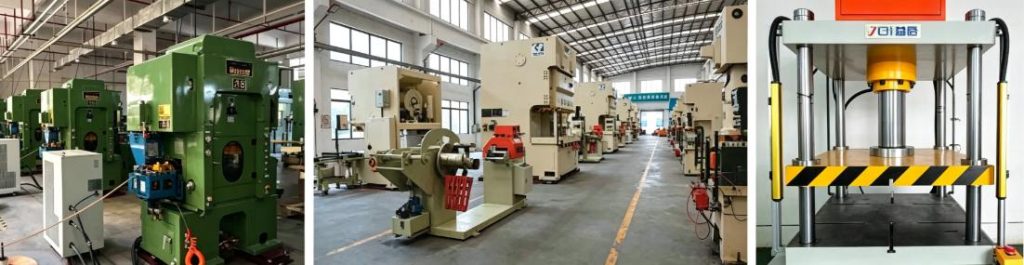
Our Core Competitive Edge:
17 Years of World-Class Delivery Expertise: Products shipped to more than 180 countries around the world; very familiar with the industrial standards of the West; provide technical language communication in English, together with FAI, PPAP and RoHS quality reports.
IATF 16949 Automotive Qualification: Dually qualified in accordance with ISO 9001:2015 and IATF 16949; following the strictest AQL 0.65 standard, keeping the qualification ratio of mass production at 99.83%.
Micron Precision and Multi-Million Stroke Tool Longevity: The machining precision level can be as high as 0.005mm; the tolerance of stamped parts is kept to ±0.01mm. Our core tools are made of tungsten carbide from imports, boasting a life expectancy of more than 10,000
Tooling-Free Rapid Prototyping: Equipped with advanced wire EDM (WEDM) technology, we can bypass formal tooling to deliver direct samples and low-volume production during the New Product Introduction (NPI) phase, saving you significant development costs and time.
Multi-Process, One-Stop Integration: Beyond core stamping, we horizontally integrate CNC precision machining, automatic lathing, precision springs, and injection molding, easily solving complex metal-plus-plastic composite assembly challenges.
Ready to Kick Off Your Custom Project?
Contact KENENG today and submit your 2D/3D drawings (STEP/IGS/CAD) or physical samples. KENENG will provide you with a complimentary, in-depth DFM review report and a highly competitive, comprehensive quotation