
Powder Coating vs. Electroplating for Metal Stamping Parts
Surface finishing contributes to the performance, durability, and appearance of metal stamping parts. When using steel, stainless steel, copper, and aluminum, the stamping process will always end in deformation. If the parts are untreated after stamping, they will be susceptible to corrosion and will quickly lose their appearance and potentially their functionality.
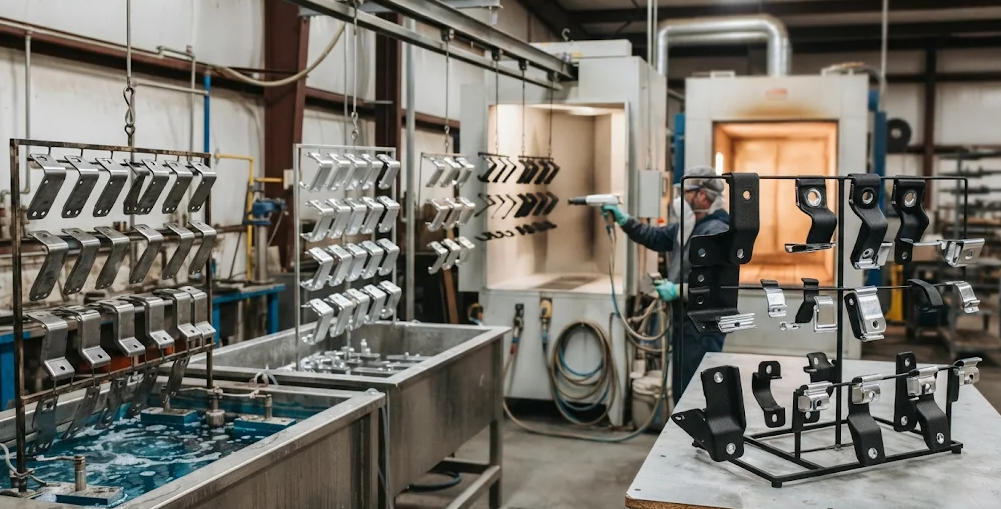
Powder coating and electroplating are two very popular surface finishing methods for metal stamping parts, and they both help to improve the surface properties of the metal component. But they work in different ways and offer distinct advantages. Powder coating creates a protective polymer layer on the metal surface, while electroplating deposits a thin metal coating through an electrochemical process.
Understanding the differences between these two finishing methods helps manufacturers select the most suitable treatment according to product requirements, operating environments, appearance expectations, and production costs
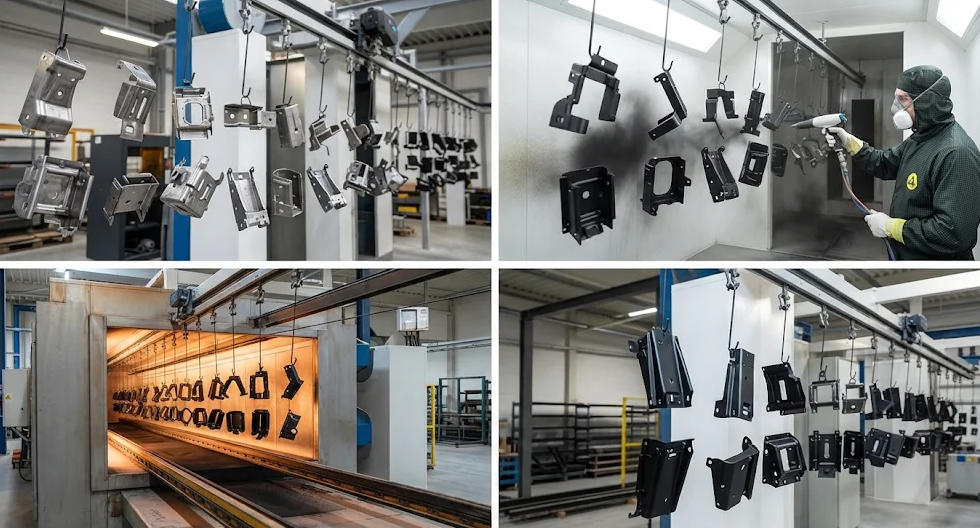
What is Powder Coating for Metal Stamping Parts?
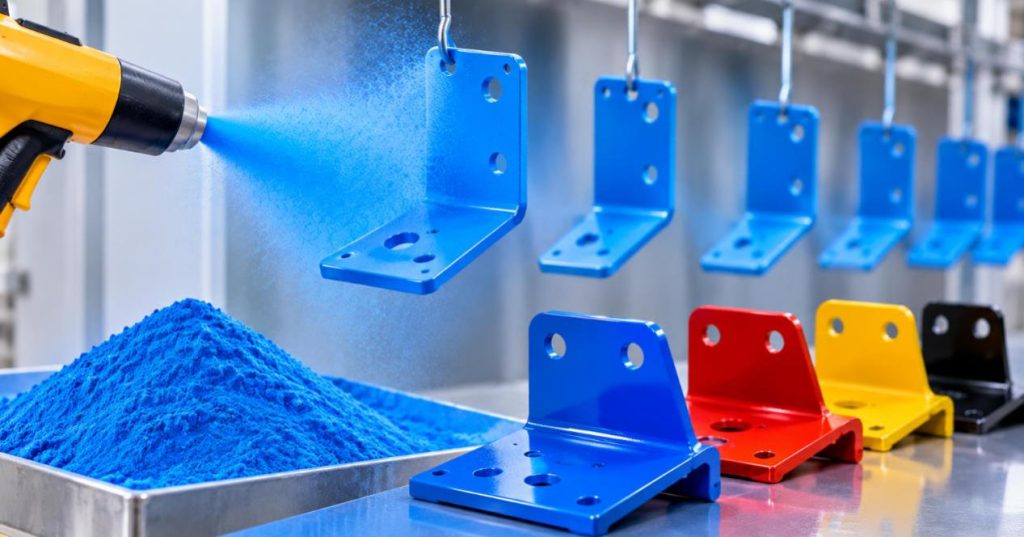
Powder coating is a dry surface finishing process that uses electrically charged powder particles to form a protective coating on metal surfaces. During the process, metal stamping parts are sprayed with electrically charged polymer powders that form a coating. The powder usually consists of a polymer, some pigment, and a few other chemicals that all serve their own purpose. To prepare the parts, they go through a very rigorous cleaning process. The metal stamping parts are cleaned to remove anything that might get in the way of the coating. Powder is applied to a metal part that is grounded, and once coated, it goes in a curing oven that causes the powder to melt and then cross-link. This coating helps protect the part and gives it an attractive look.
Many automotive metal stamped parts as well as metal stamped brackets, housings, enclosures, and cabinets, are all commonly powder coated for protection.
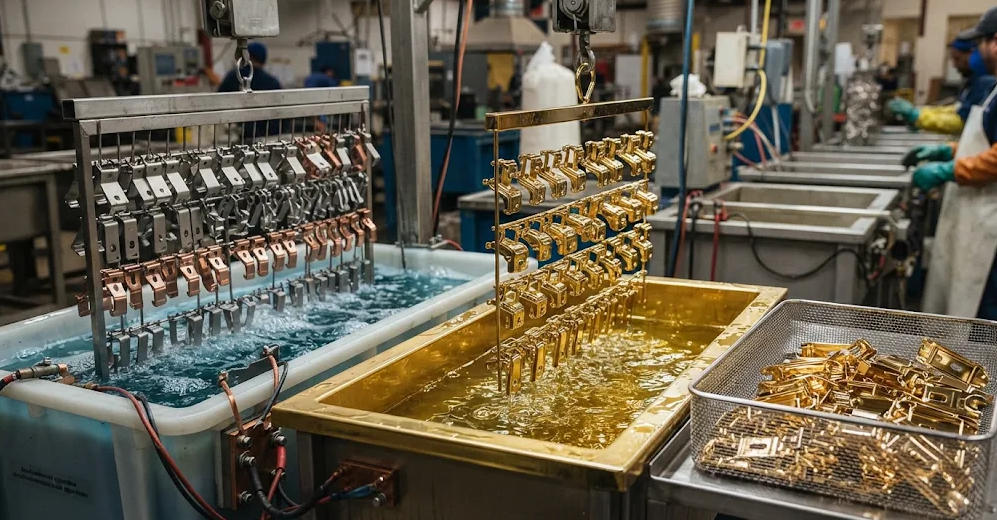
What is Electroplating for Metal Stamping Parts?
Electroplating is an electrochemical surface treatment process that deposits a thin layer of metal onto the surface of a metal stamping part. The plating materials often used include zinc, nickel, chrome, tin, copper, and silver.
For electroplating, the stamping part is usually connected to the cathode in an electrolyte bath containing the metal ions to be plated. A DC is passed through the plating bath and metal ions move towards the part and deposit themselves to create a metal plating.
Before plating, parts go through cleaning, degreasing, pickling, etc. to make sure plating adheres to the surface properly.
This electroplating is often used for things like electrical connectors, automotive fasteners, precision brackets, etc. and for decorative purposes.
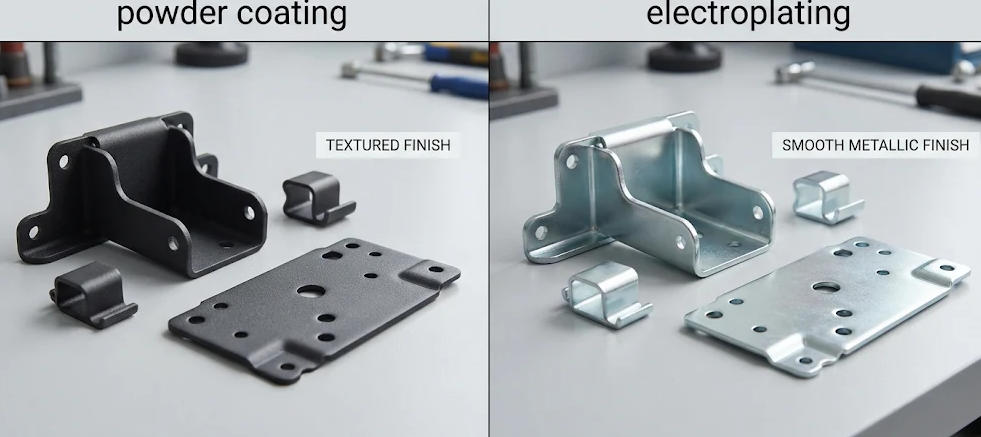
Key Differences Between Powder Coating and Electroplating for Metal Stamping Parts
1. Coating Materials
One of the most fundamental differences between powder coating and electroplating is the material used to create the surface layer.
Dry polymer materials (resin, pigment, functional additives, and a curing agent) are used for powder coating. There are many different types of powder coatings; however, some common powder coating types are epoxy, polyester, epoxy-polyester hybrids, and polyurethane coatings. Each coating type provides a coating that has different properties related to resistance to chemicals and the elements (e.g., sun and wind), flexibility, and appearance.
Metals (such as zinc, nickel, chromium, copper, tin, and silver) are used for electroplating. Unlike the coatings used in powder coating, electroplating uses a metallic material that determines the functional characteristics of the coating, such as conductivity, hardness, corrosion resistance, and decorative qualities.
For example, zinc coating can be applied to steel stamping parts as a cost-effective corrosion protection method, whereas tin can be used on electrical components to provide the solderability they require.
2. Manufacturing Processes
Powder coating and electroplating also involve different manufacturing procedures and equipment.
Powder Coating Process
Powder coating generally involves the following steps:
- Surface Preparation: Clean the stamping parts and remove all contaminants (e.g., grease and oil) and corrosion (e.g., rust).
- Pretreatment: Apply adhesion and corrosion-inhibiting cleaners and conversion coatings to prepare the surface.
- Powder Application: Spray electrostatic-charged powder coating particles on the surface of grounded stamping parts.
- Heat Curing: Heat coating parts in an oven to melt, cure, and flow the powder into a continuous film.
- Quality Inspection: Coating thickness, adhesion, surface appearance, and cure integrity are inspected.
Electroplating Process
Electroplating generally includes these operations:
- Degreasing: Remove oils and manufacturing residues from the stamped components.
- Surface cleaning: Use appropriate chemical or mechanical treatments to remove oxides and contaminants.
- Electrolyte preparation: Prepare the plating bath containing the required metal ions.
- Electrochemical deposition: Apply direct current to deposit metal onto the component surface.
- Post-treatment: Rinse, dry, and apply suitable passivation or protective treatments when required.
- Quality inspection: Evaluate coating thickness, adhesion, corrosion resistance, and surface uniformity.
The main distinction is that powder coating forms a polymer film through spraying and curing, whereas electroplating creates a metallic layer through an electrochemical reaction.
3. Corrosion Resistance
In many metal stamping applications, corrosion resistance is very important. This is true for outdoor applications, as well as for many automotive and industrial stamping applications.
Powder coating works by building up a barrier over the part via a continuous polymer coating. In addition, this barrier stops the part from directly touching elements that promote corrosion (e.g., oxygen, moisture, and certain chemicals).
Protective performance varies with coating thickness and curing, but also depends on adhesion and coating continuity. Scratches or breaks in the coating can result in exposed metal.
Electroplating can also protect against corrosion. Zinc coating on steel for instance, can protect against corrosion due to zinc’s lower oxidation potential relative to steel. Other coatings such as nickel plating also rely on a sufficiently continuous coating for protection.
Powder coating is often chosen to cover broad areas, while electroplating is preferred for coating smaller components or parts where only specific areas need to be protected.
4. Coating Thickness and Dimensional Accuracy
Coating thickness affects the dimensions, assembly and functionality of stamped parts.
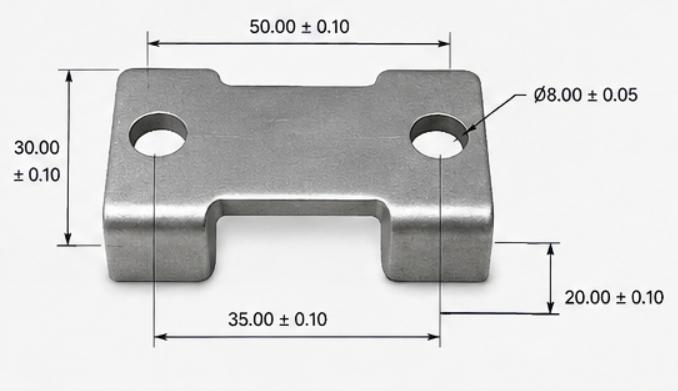
Powder coating creates a thicker coating, which increases protective performance. Unfortunately, powder coating also changes the dimensions of precision parts. For instance, too much powder coating can obstruct assembly due to accumulation around mounting holes, threaded areas, and mating surfaces.
Electrolytic metal deposition creates a thinner coating, making electroplating a good choice for smaller, more precisely toleranced parts.
Electroplating also has the problem of thickness control. Overplating can create problems in hole size and fitting.
| Factor | Powder Coating | Electroplating |
| Typical coating thickness | Commonly around 50–150 μm, depending on the application | Commonly around 5–25 μm, depending on the plating system |
| Thickness control | Controlled through powder application and curing parameters | Controlled through current density, plating time, and bath conditions |
| Impact on small holes | May reduce effective hole diameter | Usually smaller dimensional impact |
| Impact on threaded areas | May interfere with thread engagement | Can affect thread dimensions if excessive |
| Suitability for precision parts | Requires careful masking and thickness control | Often suitable for thin-film finishing requirements |
These thickness ranges are illustrative rather than universal specifications. Actual requirements depend on component design, coating material, and applicable standards.
5. Electrical Performance
Electrical performance is another important distinction between these two surface finishing methods.
Powder coatings are generally not electrically conductive. They are useful for electrical cabinets, enclosures, equipment covers and other metal parts where electrical insulation is necessary.
Powder coating can be used in parts requiring electrical contact only if specific parts of the surface are not coated.
Electroplating is more useful for metal stamping parts that need improved electrical conductivity, since electroplating uses electrically conductive metals.
Common examples include:
- Silver plating: Can be used where excellent electrical conductivity is necessary. This is especially useful for demanding contact applications.
- Copper plating: Also has excellent electrical conductivity and is useful for many applications in the electrical field.
- Tin plating: Good for solderable applications. Useful for terminals and connectors.
- Nickel plating: Useful for both mechanical and electrical applications as it protects the parts from corrosion.
Electroplating is the better option for connectors, terminals and electrical contacts.
6. Surface Appearance and Design Flexibility
Appearance requirements also influence the choice of surface finishing technology.
Customization options are broad for powder coating. You can choose different colors, gloss levels, and even add textures and different effects. Because of these customization options, powder coating is an ideal coating for many different consumer applications, such as the coatings on metal electrical cabinets or different metal stamping parts and furniture pieces.
Most electroplating gives an object a metallic look. Different plating materials and different finishing processes give different results. Bright, satin, polished and many other finishes can be achieved through different plating materials and processes.
| Appearance Requirement | Powder Coating | Electroplating |
| Multiple color options | Excellent | Limited by available plating systems |
| Matte finish | Available | Available with suitable processes |
| Glossy finish | Available | Available |
| Metallic appearance | Can imitate metallic effects | Naturally metallic |
| Textured surface | Available | More limited |
| Decorative finish | Suitable for colored designs | Suitable for metallic decorative surfaces |
| Brand color matching | Highly flexible | More limited |
Powder coating is generally preferable for customized metal stamping parts with specific brand colors or decorative textures. Electroplating is more appropriate when a genuine metallic finish is important.
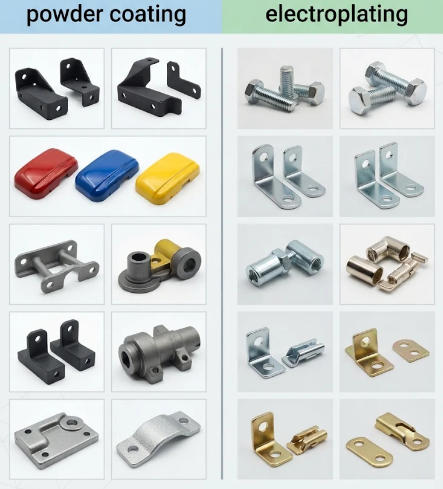
7. Production Costs and Efficiency
The costs to produce different metal stamping parts vary based on the volume of production, complexity of the parts, material used, investment of machines, and the quality standards that are needed.
To begin powder coating, spray booths and electrostatic application systems, curing ovens, and material handling systems must be invested. While the upfront investment of the equipment is substantial, for larger volume production and coating large surface areas, powder coating becomes an efficient method to produce parts.
Electroplating requires specialized plating tanks, power supplies, chemical solutions, rinsing systems, and wastewater treatment facilities. Its operating costs are influenced by the type and quantity of plating materials, chemical maintenance, electricity consumption, and environmental compliance.
| Cost Factor | Powder Coating | Electroplating |
| Equipment investment | Spray systems and curing ovens | Plating tanks and power supplies |
| Material expenses | Polymer powder | Plating metals and chemicals |
| Energy requirements | Mainly oven curing | Electrochemical deposition and supporting equipment |
| Labor requirements | Pretreatment, spraying, and curing | Cleaning, plating, rinsing, and inspection |
| Waste management | Powder collection and disposal | Chemical waste and wastewater treatment |
| Production efficiency | Good for batch and continuous coating | Good for suitable automated plating lines |
| Cost advantages | Large surfaces and colored components | Thin metallic coatings and functional surfaces |
Manufacturers should compare the total cost per finished component rather than evaluating only the price of coating materials.
8. Applications in Metal Stamping Industries
Different industries have different metal stamping surface finishing requirements. The following examples illustrate where each process is commonly used.
| Industry | Metal Stamping Parts | Recommended Surface Treatment | Main Purpose |
| Automotive | Brackets and structural supports | Powder coating or zinc plating | Corrosion protection and durability |
| Electronics | Electrical enclosures | Powder coating | Insulation and surface protection |
| Electronics | Connectors and terminals | Tin, nickel, or silver plating | Electrical conductivity and solderability |
| Electrical equipment | Control cabinet panels | Powder coating | Insulation and corrosion resistance |
| Home appliances | Appliance brackets and housings | Powder coating | Appearance and surface protection |
| Industrial machinery | Mounting plates and protective covers | Powder coating | Wear and corrosion resistance |
| Hardware | Steel fasteners | Zinc or nickel plating | Corrosion protection and appearance |
| Telecommunications | Electrical contact components | Tin or silver plating | Reliable electrical connections |
| Furniture | Decorative metal brackets | Powder coating or nickel plating | Appearance and durability |
| Precision instruments | Small metal components | Nickel plating | Surface protection and dimensional control |
The final selection should always account for the actual material, operating conditions, functional requirements, and applicable industry standards.
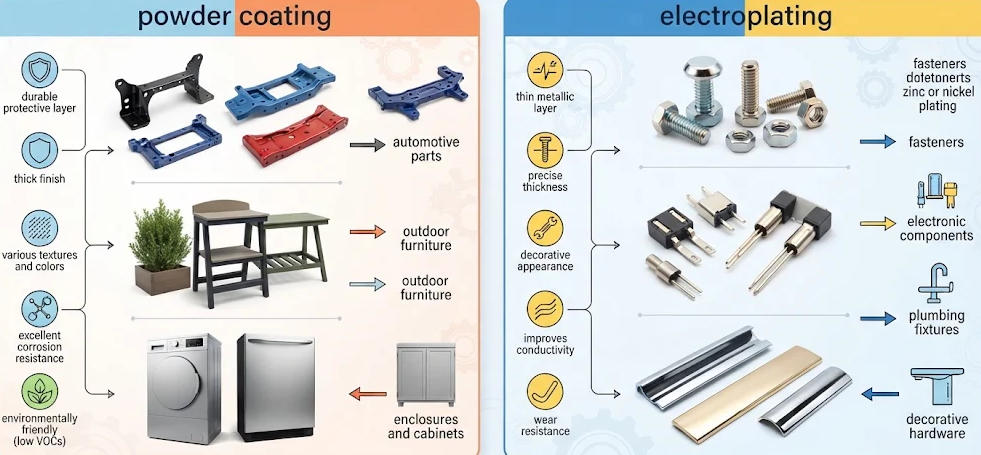
Summary Comparison Table of Powder Coating and Electroplating
| Comparison Factor | Powder Coating | Electroplating |
| Basic Principle | Applies polymer powder to the metal surface through electrostatic spraying and heat curing | Deposits a thin metallic layer through an electrochemical process |
| Coating Material | Epoxy, polyester, polyurethane, and hybrid powders | Zinc, nickel, chromium, copper, tin, and silver |
| Application Method | Electrostatic powder spraying | Electrochemical metal deposition |
| Coating Thickness | Generally thicker, commonly 50–150 μm | Generally thinner, commonly 5–25 μm |
| Surface Appearance | Matte, glossy, textured, and various colors | Metallic, polished, bright, or satin finishes |
| Corrosion Resistance | Protects metal through a continuous polymer barrier | Provides barrier or sacrificial protection, depending on plating material |
| Wear Resistance | Good, depending on powder formulation and curing | Depends on metal type, hardness, and coating thickness |
| Electrical Conductivity | Generally nonconductive | Can provide excellent electrical conductivity |
| Electrical Insulation | Suitable for insulating metal surfaces | Generally not suitable for electrical insulation |
| Solderability | Generally unsuitable for soldering surfaces | Tin and other suitable plating systems offer good solderability |
| Dimensional Accuracy | Thicker coating may affect holes, threads, and assembly clearances | Thin coating generally has less dimensional impact |
| Heat Resistance | Depends on polymer formulation and operating temperature | Depends on plating metal and substrate |
| Surface Customization | Wide selection of colors, textures, and gloss levels | More limited color options but offers genuine metallic finishes |
| Equipment Requirements | Spray booths, electrostatic guns, and curing ovens | Plating tanks, power supplies, chemical baths, and rinsing systems |
| Environmental Impact | Low VOC emissions and potential powder recovery | Requires chemical handling and wastewater treatment |
| Production Cost | Often economical for large surfaces and colored components | Depends on plating metal, thickness, and chemical processing |
| Typical Applications | Metal enclosures, brackets, housings, and protective covers | Electrical terminals, connectors, fasteners, and precision components |
| Main Advantage | Durable protective coating with flexible appearance customization | Thin functional metallic coating with electrical and surface property benefits |
| Main Limitation | Relatively thick coating and possible dimensional changes | Chemical management and potential coating thickness variation |
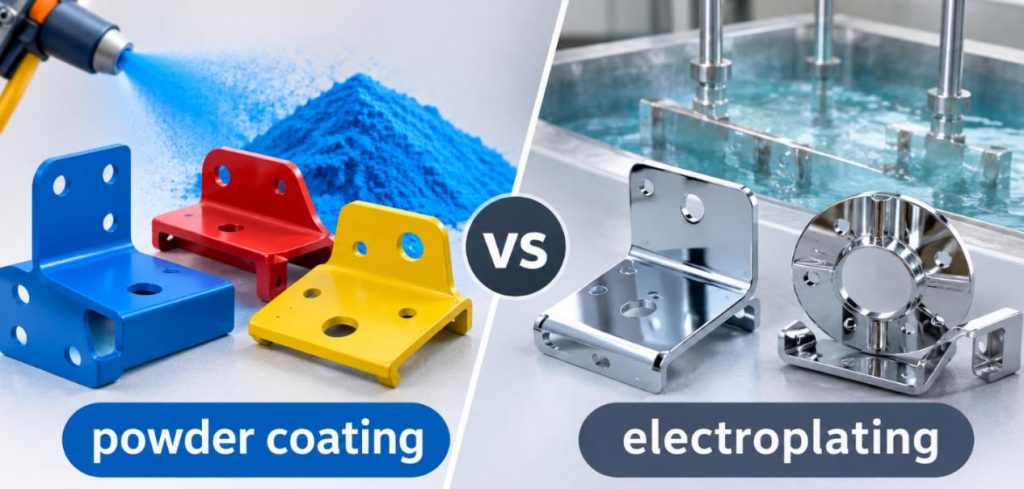
Which Method Should Manufacturers Choose Between Powder Coating and Electroplating?
Selecting the right surface finishing process requires a comprehensive evaluation of the metal stamping part’s intended use.
- Consider the Functional Requirements
Powder coating will serve better if your metal stamping part must perform in an electrically nonconductive application. For metal stamping parts requiring electrically conductive applications, electroplating will be better. Electrically conductive parts are also used for solderable joints and metallic contacts.
- Evaluate the Operating Environment
Outdoor and high moisture or industrial environments will require a higher degree of protection and testing of the corrosion resistance of your coating.
- Check Dimensional Tolerances
Many precision stamping parts have close tolerance specifications. Powder coating tends to have a greater build-up and can affect tolerances of holes and fitment of mating and assembly parts. If a thinner metallic coating is acceptable for your parts, then electroplating might be the way to go.
- Determine the Desired Appearance
If you want different colors and textures on your part, then powder coating is for you. If you want a metallic coating, with or without a shiny look, or even want it to look like a certain type of metal, then electroplating is your best bet.
- Compare Production Costs
You have to look at the costs for equipment, materials, the quantity of parts, labor, energy, and costs for the disposal of any hazardous waste (if any). Depending on your design, coating requirements and volumes, one way might be more economical.
- Consider Material Compatibility
Different substrates require their own unique finishing steps and pretreatment steps. To ensure optimal coating performance and adhesion, steel, stainless steel, aluminum and copper might all require specific steps in their preparation.
Summary
- Powder coating is generally suitable for components requiring attractive colors, durable surface protection, electrical insulation, and coverage of relatively large areas.
- Electroplating is often preferable for precision metal stamping parts that require thin metallic coatings, electrical conductivity, solderability, or specific metallic surface properties.
Can Powder Coating and Electroplating Be Combined?
For certain applications, powder coating and electroplating can be used together to create a complementary and even more robust protective surface and can improve functionality.
A typical application is applying a zinc electroplate to steel metal stampings for protection against corrosion. A powder coat can then be added as a layer to improve corrosion resistance and for aesthetic purposes.
Combining these two methods is useful for protective enclosure housings for electrical equipment, industrial equipment housings, and for some automotive applications.
Using both methods at the same time is complex and requires control of several processes, including surface preparation, coating adhesion, compatibility, curing temperature and dimensional tolerances. Testing of both coating adhesion and corrosion resistance is advised for mass production.
Final Thoughts
Powder coating and electroplating are both valuable surface finishing methods for metal stamping parts. But they apply to different manufacturing situations and performance requirements.
The key differences between the two metal stamping part surface finishing methods include materials, application processes, coating thickness, corrosion-protective mechanisms, electrical performance, appearance, and production costs.
Decisions on which method to apply require balancing functional performance, product design, manufacturing efficiency, and budget. Having an understanding of these differences, metal stamping manufacturers will improve product quality, optimize production processes, and improve their ability to fulfill the customer’s application requirements.