
Medical Metal Stamping: Why Stamping is Indispensable for Medical Device Manufacturing
In the modern medical device industry, every micro-component directly impacts patient safety and the clinical performance of equipment. From minimally invasive surgical instruments and implantable biochips to large-scale clinical diagnostic analyzers, the core components behind countless devices rely heavily on a critical manufacturing process: Medical Metal Stamping.
As the global medical device market pushes the demand for “miniaturization, high precision, and cost-effective mass production” to unprecedented heights, precision stamping has become an indispensable technological cornerstone in medical manufacturing. This article provides an in-depth analysis of the core processes, application scenarios, material selection, and supplier evaluation criteria for medical metal stamping.
Table of Contents
What is Medical Metal Stamping?
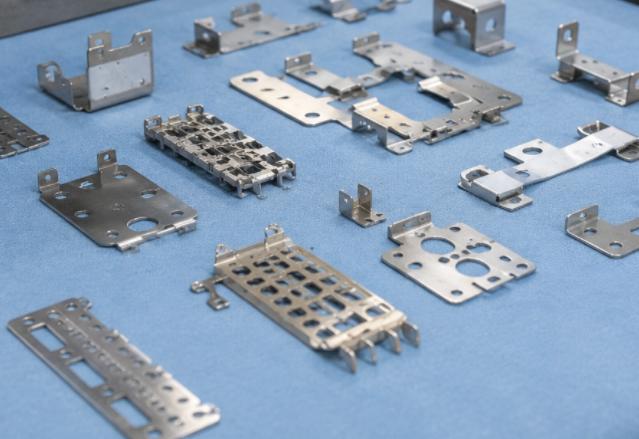
Metal stamping for medical applications is a highly precise production technique involving the use of high-precision dies and high-speed stamping presses for operations such as cold forming, cutting, punching, bending, and deep drawing of metal sheets or strips.
In contrast to regular industrial stamping, metal stamping for medical uses imposes almost stringent standards of tolerance control, surface finish, sterility, and tracking of raw material usage.
Core Stamping Process Classifications
Progressive Die Stamping: Combines several processes into one die that runs the strip of metal material at high speed through all operations in one cycle. This is one of the main techniques to get consistency and volume.
Deep Drawing: Applicable to manufacture of cup-like products where the length of the component exceeds the diameter (like pacemaker housing and catheter).
Micro-Stamping: Specifically applied to manufacture extremely small components of medical equipment, when the size can be in millimeters, which puts the extreme test for the tooling shop.
Fine Blanking & Piercing: Provides perfectly smooth and burr-free edges of sheared pieces, which is crucial for medical devices.
Why Medical Manufacturing Heavily Relies on Precision Metal Stamping?
Precision metal stamping overcomes the challenge posed by the combination of high accuracy, compliance, and cost during the research and development to production stage of medical equipment as follows:
1. Ultra-Micro Tolerance Capability
Ultra-micro parts including medical sensors and catheter contacts are responsible for important tasks such as signal transduction or mechanical latching. Precision stamping is able to provide dimensional tolerance down to ±0.01mm to ±0.025mm without any malfunction in extreme conditions.
2. Overwhelming Mass Production Efficiency and Cost Advantages
When moving on to mass production, stamping will be more advantageous than CNC machining in regards to:
Production Speed: Progressive dies operating at high speeds can produce hundreds or even thousands of pieces per minute.
Efficient Material Usage: Stamping is a chipless manufacturing method, hence reducing waste of costly raw materials used in manufacturing medical products such as titanium alloy and precious metals.
3. Near-Perfect Batch Consistency
The medical industry operates on a near-zero tolerance policy for defect rates. Through fully automated feeding, precision die control, and in-line vision inspection, the stamping process ensures that the 1st part and the 1,000,000th part share the exact same dimensional chain and mechanical properties.
Core Application Areas of Medical Metal Stamping
| Application Sector | Typical Stamped Components | Core Process Requirements |
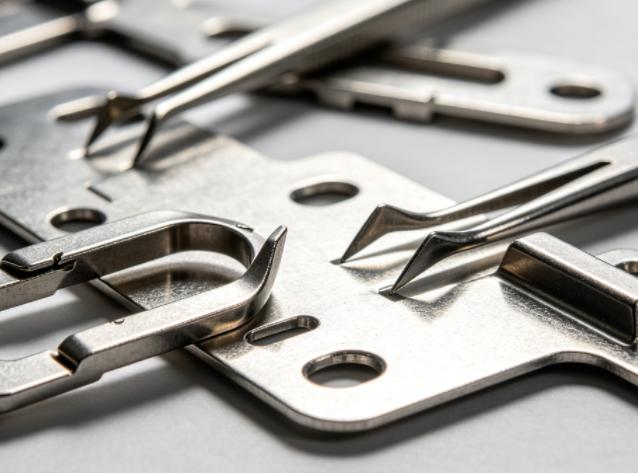
| Surgical Instruments | Surgical clips, endoscopic suture staple components, hemostatic forceps joints, trocar needles | High strength, burr-free edges, resistance to repeated autoclaving/sterilization |
| Implantable Medical Devices | Orthopedic fixation plates, spinal clips, pacemaker enclosures, dental implants | Absolute biocompatibility, extremely high surface finish |
| Smart Medical Electronics | Blood glucose meter battery contacts, shielding cans, micro-connector terminals, sensor spring contacts | Excellent electrical conductivity, structural miniaturization, EMI shielding |
| In-Vitro Diagnostics (IVD) Equipment | Reagent tray brackets, precision pump/valve spring plates, diagnostic module structural parts | Complex geometries, high corrosion resistance |
Strict Standards for Medical-Grade Stamping Materials
In medical device manufacturing, the materials used in metal stamping not only dictate the mechanical lifespan and structural strength of components but also directly impact human biocompatibility and clinical safety. Medical-grade stamping requires stringent metrics for material purity, microstructural uniformity, and surface defects. Below are the four core medical-grade stamping metals used in clinical applications:
1. Stainless Steel
Stainless steel is currently the most cost-effective and widely used metal in medical stamping. It features excellent tensile strength, superb wear resistance, and can withstand repeated high-temperature, high-pressure autoclaving or chemical disinfection.
Common Grades & Technical Attributes:
SUS304: Possesses high formability and oxidation resistance properties; it is widely used in general medical equipment that does not include implants, along with disposable consumables.
SUS316: Contains Molybdenum (Mo), which makes it more resistant to chloride corrosion as compared to 304, especially in solutions like saline and other biological solutions.
SUS316L (Ultra Low-Carbon Stainless Steel): It limits the carbon percentage in the alloy to less than 0.03%, thus eliminating intergranular corrosion. Because of its immunity, it is regarded as a good “implant-grade” stainless steel.
Deep-Dive Applications: Endoscopic surgical blades, endoscopic suture staples, trocar injection needles, hemostatic forceps joints, dental instruments, and load-bearing frames for various minimally invasive surgical tools.
2. Titanium & Titanium Alloys
Titanium alloys are renowned for their exceptional biocompatibility, high specific strength (high strength, low weight), and absolute inertness within the human body. More importantly, titanium possesses a unique property of osseointegration, allowing it to bond tightly with human bone.
Common Grades & Process Challenges:
Common grades include Pure Titanium (Gr1/Gr2) and Ti-6Al-4V ELI (Gr5 Extra Low Interstitial).
Process Bottlenecks: Titanium alloys exhibit low thermal conductivity and severe work hardening, making them highly prone to springback or causing severe die wear during stamping. This demands that stamping suppliers possess exceptional capabilities in die clearance control and surface coating technologies.
Deep-Dive Applications: Long-term internal bone plates, bone screws, spinal fixation clips, joint replacement retention components, as well as ultra-thin micro-enclosures for cardiac pacemakers and implantable neurostimulators.
3. Aluminum Alloys
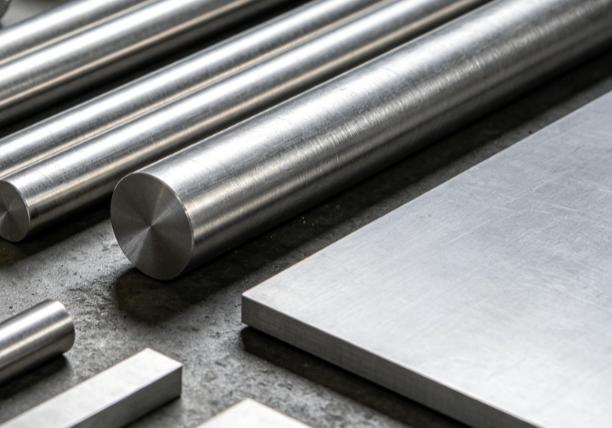
The core benefits of aluminum alloys lie in their ultra-low density (roughly one-third that of stainless steel), outstanding heat dissipation, and excellent anodizing capabilities, the latter allowing for functional color-coding on medical devices.
Common Grades & Attributes:
High-strength aluminum alloys such as 6061, 5052, or 7075 are frequently adopted. While aluminum is not used for direct human implants, it is irreplaceable in medical equipment requiring frequent handheld operation or rapid heat dissipation.
Deep-Dive Applications: Lightweight housings for handheld power surgical tools (e.g., bone saws, bone drills), large-scale precision structural parts for IVD instruments, portable ultrasound equipment frames, ECG monitor enclosures, and heat dissipation assemblies for operating room surgical lights.
4.Copper & Copper Alloys
In the era of smart medicine and medical electronics, high-precision signal acquisition and power transmission are paramount. Copper alloys have become the absolute core of medical electronic stamping due to their unparalleled electrical/thermal conductivity and excellent fatigue life.
Common Grades & Functional Attributes:
Beryllium Copper (such as C17200): Provides outstanding strength characteristics with a very high fatigue resistance to withstand any deformation or breakage due to multiple insertions and bending.
Phosphor Bronze (such as C5191): Has outstanding properties in resisting abrasion and chemical corrosion.
Deep-Dive Applications: Shielding cans used in MRI/CT machines, micro-springs in glucose/oxygen meters, terminals in highly sensitive medical devices, and connectors used in multi-core medical wire harnesses.
Standardized Medical Stamping Manufacturing Workflow
A standardized process flow is essential to ensure that medical parts successfully pass regulatory audits:
DFM Optimization: During early R&D phase, the engineers join to optimize the part geometry in order to minimize the risk of tears in stamping and tooling risk.
Die Design & Validation: The die tooling is made using extremely wear resistant material such as tungsten carbide and is subject to IQ/OQ/PQ validation.
Precision Stamping Production: Precision stamping operations are done in temperature-controlled and clean room environment.
Post-Processing & Secondary Operations: This may include precision deburring (to prevent any metal sliver getting into the human body), ultrasonic cleaning (remove stamping oil), passivation or laser marking.
Rigorous Inspection: Using Video Measurement System, Coordinate Measurement Machine and AOI measurement for precise dimension validation.
Core Comparison: Medical Metal Stamping vs. CNC Machining
The medical OEMs generally assess the processes of metal stamping and CNC machining at various stages of the product’s lifecycle as follows:
Metal CNC Machining: No need for costly tooling investments and great flexibility in designing. This process is ideal for R&D and low-volume prototype development.
Medical Metal Stamping: Even though it involves higher tooling investments and longer design cycles initially, when it comes to mid-volume and high-volume mass production, the part cost becomes extremely low.
The Industry’s Golden Workflow: “CNC for early-stage prototyping and design validation → Hard tooling for stamping when transitioning to mass production.”
Core Access Standards and Compliance Requirements for Medical Stamping
To enter the medical supply chain, suppliers must build an ironclad compliance firewall:
ISO 13485 Certification: The universal quality management system standard for the medical device industry, proving a company’s systematic capability to consistently provide medical-grade components.
ISO 9001 Certification: The foundational quality management framework.
Traceability for Full Process: From MTR of raw materials and stamping batches through to heat treatment information and finished product inspections, the full process record must be completely traceable. Typically, this data needs to be kept on file for more than 10 years.
Particulate Contamination Control: Specific high-grade parts, such as those which are implantable, have requirements to be cleaned and packed inside an ISO Class 7 or 8 cleanroom.
How to Select an Irreplaceable Medical Stamping Supplier?
For an audit of global or local medical stamping services providers, OEMs are recommended to consider the following essential aspects when assessing potential partners:
Industrial Experience and Case Studies: Check if they have worked for tier-one medical devices and if they are familiar with terminologies used in the medical industry.
Tool and Die R&D Capabilities within Suppliers: High-end suppliers must have their own team for precision tool and die development and research. The accuracy of dies and longevity of tools will decide the deadlines and consistency in quality.
Strong Systems of Validation: Make sure that they can offer documentation for PPAP, IQ/OQ/PQ validations, and material certifications.
One-Stop Solution Providers: Go for turnkey providers who offer services like “stamp + machine + ultrasonic cleaning + passivation/packaging.” This will help minimize the contamination hazards and logistical costs involved in working with different vendors.
Summary
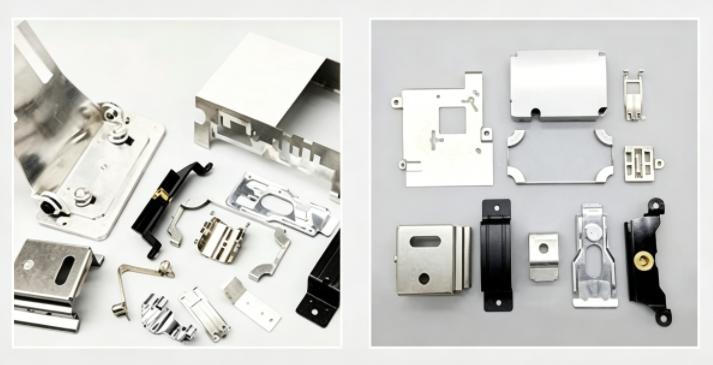
Prompted by the rapid expansion of minimally invasive surgery, wearable devices, and telehealth care, medical metal stamping is fast developing towards miniaturization, complexity, and higher barrier materials. For medical brand makers, precision metal stamping is not merely a way of cutting costs during manufacturing, but a key strategic asset that ensures the safety of their products and reduces time to market. Partnering with a professionally vetted stamping expert with robust engineering depth, such as KENENG, will serve as a definitive edge for companies looking to stand out in a highly competitive market.