Understanding Bolt Grades: What You Need to Know?
Table of Contents
Choosing bolts only by size? Choosing the wrong grade can lead to breakage and safety hazards! This article helps you fully understand bolt grades so you can select the right ones without mistake
What are Bolt Grades
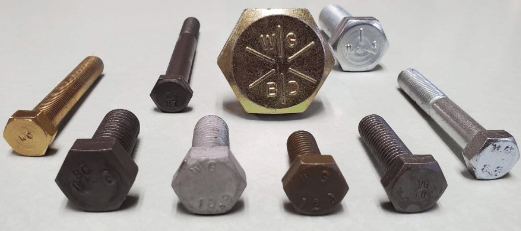
Bolt grades are a standardized way of categorizing bolts based on their mechanical properties, such as tensile strength, yield strength, and hardness. These grades ensure that bolts meet the specific demands of different applications. Bolt grades are typically determined by two main standards:
- Metric System (ISO): Common worldwide, used for metric bolts.
- Imperial System (SAE): Common in the United States and for imperial bolts.
Key Features
- Strength: Bolt grades specify the tensile strength (the maximum force a bolt can endure before breaking) and yield strength (the force at which a bolt deforms permanently).
- Material: Different grades correspond to specific materials, such as low-carbon steel, medium-carbon steel, or alloy steel.
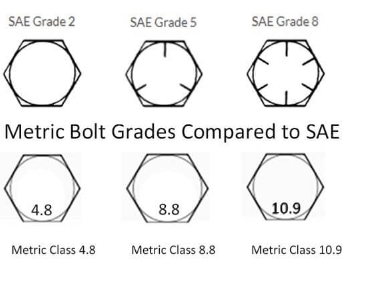
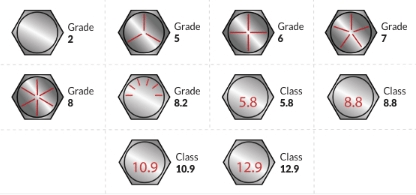
- Markings: Bolt heads are marked with grade identifiers, such as numbers or radial lines, which allow for quick identification.
- Standards: Bolt grades are standardized by organizations like ISO (International Standards Organization) for metric bolts and SAE (Society of Automotive Engineers) for imperial bolts.
Common Applications
- Low-Grade Bolts: For light-duty applications such as furniture assembly or household repairs (e.g., Metric 4.6, SAE Grade 2).
- Medium-Grade Bolts: For automotive components and moderate-strength machinery (e.g., Metric 8.8, SAE Grade 5).
- High-Grade Bolts: For heavy machinery, structural connections, and critical load-bearing applications (e.g., Metric 10.9, SAE Grade 8).
Understanding Metric Bolt Grades
Metric bolt grades provide a clear classification system for identifying the mechanical properties and strength of bolts. This system, standardized by the International Organization for Standardization (ISO), is widely used across industries globally. They are indicated by a two-part number system stamped on the bolt head, such as 4.6, 8.8, 10.9, or 12.9. These numbers denote the tensile strength and yield strength ratio of the bolt, which define its load-bearing capacity and elasticity.
This chart helps quickly match the appropriate bolt grade to your application based on strength and use case.
| Grade | Tensile Strength (MPa) | Yield Strength (MPa) | Yield Ratio (%) | Applications |
| 4.6 | 400 | 240 | 60% | Light-duty applications: furniture, light fixtures, general-purpose fastening. |
| 8.8 | 800 | 640 | 80% | Medium-strength applications: automotive, machinery, construction. |
| 10.9 | 1,000 | 900 | 90% | High-load environments: heavy machinery, structural connections. |
| 12.9 | 1,200 | 1,080 | 90% | Critical, high-stress tasks: aerospace, industrial equipment, engines. |
How to Read the Bolt Grade Markings
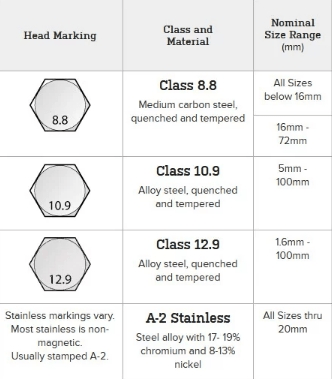
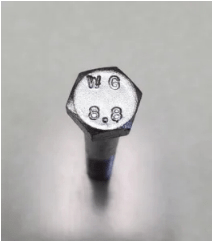
The first number indicates one-tenth of the tensile strength (e.g., 8 = 800 MPa).
The second number is the yield strength as a percentage of the tensile strength (e.g., 8 = 80% of 800 MPa = 640 MPa).
Understanding SAE Bolt Grades
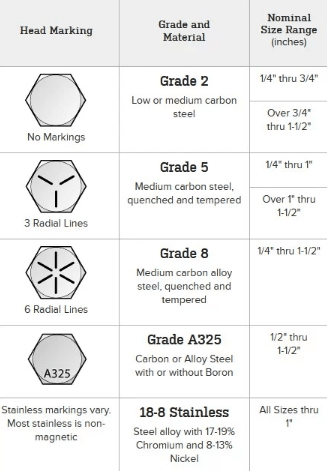
SAE (Society of Automotive Engineers) bolt grades are widely used in the United States to classify bolts based on their material composition and mechanical properties. They use a marking system on the bolt head to indicate the strength and mechanical properties of the bolt. These markings are made up of radial lines, which correspond to specific grades and provide critical information about the bolt’s performance characteristics.
This chart provides a quick overview to help choose the right SAE bolt grade based on strength requirements and application needs.
| Grade | Material | Tensile Strength (PSI) | Yield Strength (PSI) | Identification Marking | Applications |
| Grade 2 | Low-carbon steel | ~74,000 | ~57,000 | No radial lines | Light-duty tasks: furniture, household repairs, non-critical applications. |
| Grade 5 | Medium-carbon steel, heat-treated | ~120,000 | ~92,000 | Three radial lines | Automotive components, moderate-strength machinery, and structural connections. |
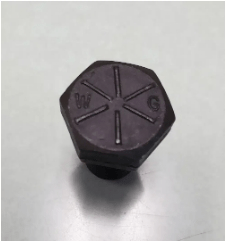
| Grade 8 | Medium-carbon alloy steel, heat-treated | ~150,000 | ~130,000 | Six radial lines | Heavy machinery, industrial equipment, high-load, and high-stress environments. |
How to Identify SAE Bolt Grades
- No Lines: Grade 2 (basic strength).
- Three Lines: Grade 5 (medium strength).
- Six Lines: Grade 8 (high strength).
Correlation Between Bolt Performance Grades and Materials
| Performance Grade | Nominal Tensile Strength (MPa) | Yield Ratio | Nominal Yield Strength (MPa) | Common Materials | Heat Treatment | Typical Applications |
| 4.8 | 400 | 0.8 | 320 | Q235, 10 Steel | None | Furniture, light equipment, general fastening |
| 5.6 | 500 | 0.6 | 300 | Low-carbon Steel | None | General mechanical structures |
| 6.8 | 600 | 0.8 | 480 | Medium-carbon Steel | None or Normalizing | Industrial supports, non-critical connections |
| 8.8 | 800 | 0.8 | 640 | 45#, 40Cr, Q345 | Quenching + Tempering | Building steel structures, automobile chassis, mechanical transmission |
| 9.8 | 900 | 0.8 | 720 | Alloy Steel | Quenching + Tempering | Heavy-duty machinery, railway connections |
| 10.9 | 1000 | 0.9 | 900 | 35CrMoA, 40CrNiMoA | Quenching + Tempering | Bridges, hoisting equipment, high-speed trains |
| 12.9 | 1200 | 0.9 | 1080 | SCM435, 42CrMo | Quenching + Tempering | Aerospace, precision instruments, high-stress environments |
Carbon Steel / Alloy Steel / Stainless Steel Corresponding Grades
| Category | Chinese Grade | ASTM Standard | Corresponding Grade/No. |
| Carbon Steel | Q235 | ASTM A36 | Structural carbon steel, yield ≥ 250 MPa |
| Carbon Steel | 45 Steel | ASTM A29/A29M | 1045 steel, medium-carbon structural steel |
| Alloy Steel | 40Cr | ASTM A29/A29M | 4140 steel, chromium-molybdenum alloy steel |
| Stainless Steel | 304 | ASTM A276 | UNS S30400, austenitic |
| Stainless Steel | 316L | ASTM A276 | UNS S31603, molybdenum-bearing austenitic |
| Stainless Steel | 410 | ASTM A276 | UNS S41000, martensitic |
| Stainless Steel | 430 | ASTM A276 | UNS S43000, ferritic |
Simple Logic for Bolt Selection
Selecting the appropriate bolt grade is crucial for ensuring safety, durability, and functionality in various applications.
Static load, low-vibration environment → Use Class 8.8 carbon steel bolts. Suitable for general mechanical assembly, light supports, non-critical connections; low cost and mature process.
Dynamic load, medium-high vibration, alternating stress scenarios → Prioritize Class 10.9 alloy steel bolts. Suitable for wind turbine flanges, automobile chassis, construction machinery, drive shafts, etc.; fatigue resistance is significantly better than Class 8.8.
Extreme load, safety-critical structures, impact load → Must use Class 12.9 high-strength alloy steel bolts. Suitable for bridge cables, pressure vessels, aerospace components, heavy-duty hoisting equipment; requires hydrogen embrittlement protection and precise preload control.
Corrosive environments (humidity, salt spray, chemicals) → Use 304 or 316L stainless steel bolts; carbon steel or 410 stainless steel is prohibited. Even with low load, corrosion resistance should be prioritized; if high load is also required, use stainless steel bolts + alloy steel bushings or coated alloy steel solutions.
Flange connections, metal gasket working conditions → Stainless steel bolts are prohibited (insufficient strength); Class 10.9 or 12.9 alloy steel must be used; surface can be nickel-plated or Dacromet-coated for rust prevention.
Final Thoughts
Bolt grades provide crucial information about a bolt’s strength and suitability for various tasks. Understanding these grades allows you to select bolts that meet the strength, durability, and environmental requirements of your project. By choosing the correct bolt grade, you can enhance the safety, performance, and longevity of your application.