
How to Manufacture Ultra-thin Metal Stamping Parts?
As products get more and more compact and lightweight, manufacturers end up needing metal pieces with thicknesses that vary from just a few micrometers up to under 0.2 mm, while still keeping that exceptional dimensional accuracy and reliability. But honestly, manufacturing ultra-thin metal stamping parts is way harder than the usual stamped parts that people are used to. These thin materials are real delicate, so they can easily deform, wrinkle, start creating burrs, and then show dimensional instability as well. In order to keep the results consistent, manufacturers have to mix advanced tooling with precision equipment, put careful process control in place and also do strict quality inspection during basically the whole run.
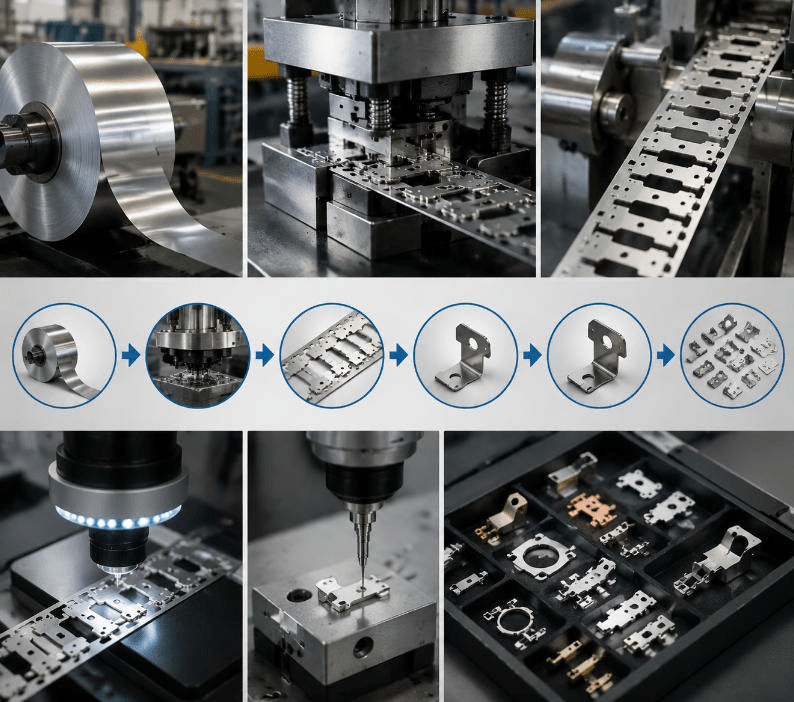
Table of Contents
Understanding Ultra-thin Metal Stamping Parts
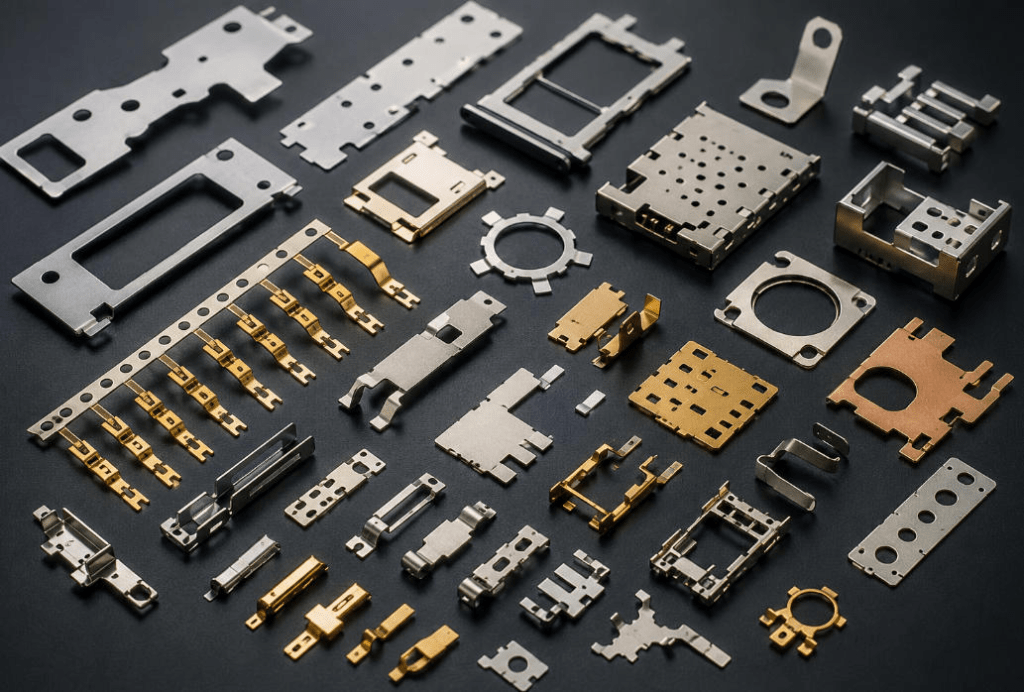
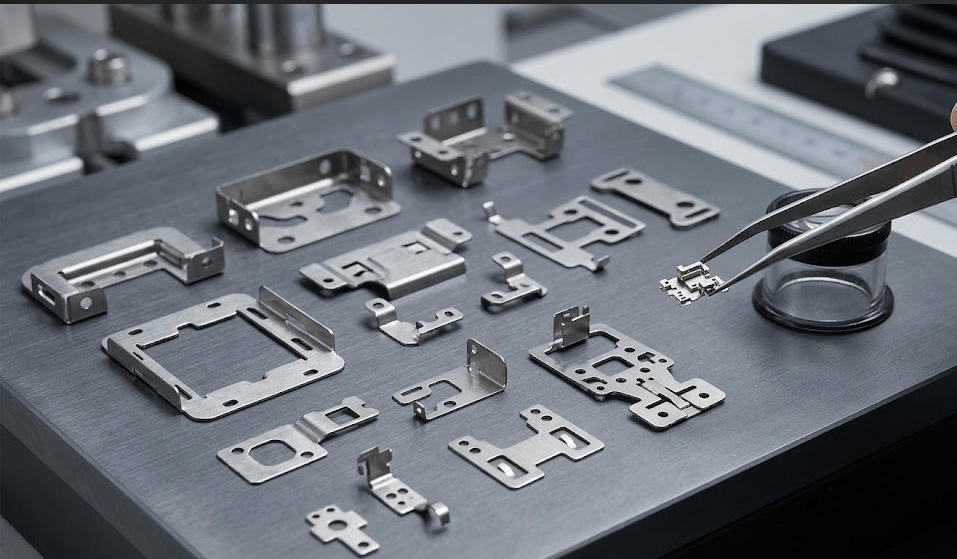
Ultra-thin metal stamping parts are metal components made from sheets or strips where the thickness is very small, usually somewhere between a few micrometers and a portion of a millimeter. They’re made with precision stamping methods that shape, cut, bend, or otherwise form the metal into complicated shapes and details.
Common material choices for ultra-thin stamped parts include stainless steel, copper, aluminum, brass, phosphor bronze, nickel alloys, and specialty metals picked for particular mechanical needs, electrical performance, or corrosion resistance.
Because the dimensions are so fragile, ultra thin stamped parts need manufacturing settings that are tightly controlled, and specialized tools, so they can achieve stable quality and reliable performance.
The Manufacturing Process of Ultra-thin Metal Stamping Parts
1. Material Selection and Preparation
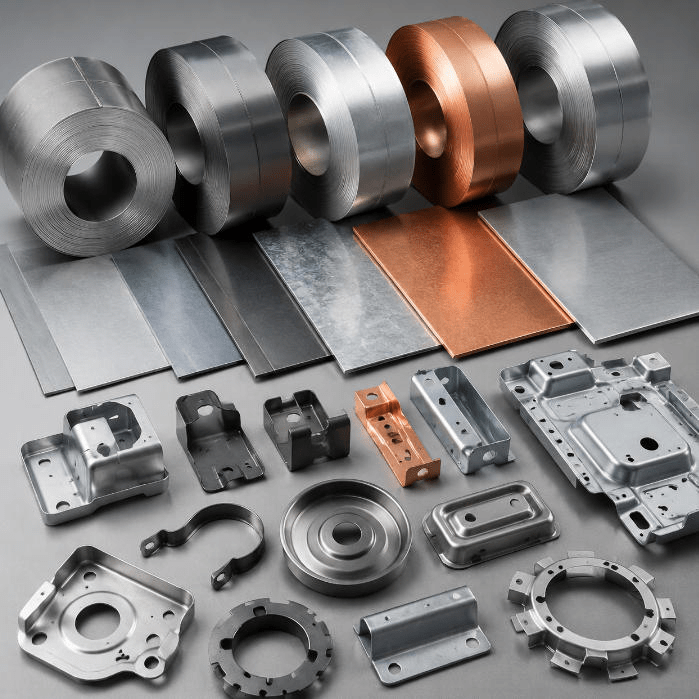
The manufacturing process starts with a careful selection of materials for metal stamped parts. Things like thickness tolerance, hardness, tensile strength, the grain structure, and the surface finish all influence how well the stamping goes and how good the final item looks or performs.
Ultra thin materials are usually delivered as coils, because continuous production makes sense there. Before the material reaches the production line, it goes through an inspection step to confirm dimensional consistency, and also that the surface quality is acceptable. If there is any variation in thickness, or if the material properties shift even a bit, defects can show up during the stamping, so quality control right at this stage is not optional.
Storage and handling also matter a lot, since thin metal sheets scratch easily, can get contaminated, or even end up distorted if they are treated carelessly, or stacked wrong, something like that.
2. Precision Tooling Design
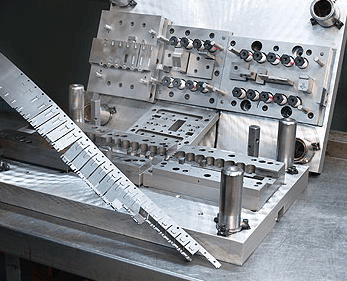
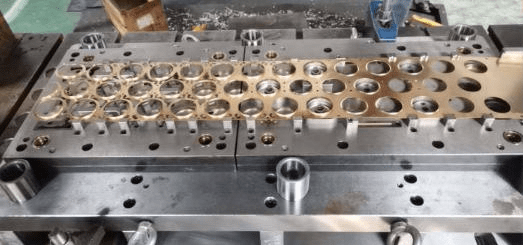
Tooling is one of the most critical things in manufacturing ultra-thin metal stamping pieces. The dies along with punches really have to be designed and made with very tight tolerances, so you can hit the precise dimensions and keep the edge quality where it should be.
Engineers often rely on advanced CAD systems and simulation utilities to work through die geometry and foresee how the material behaves while forming. Details like punch-to-die clearance, how the material flows, springback effects, and stress distribution across the section get checked again and again in the design stage.
To keep wear down and preserve steady output during long production runs, manufacturers commonly select high-quality tool steels, and advanced surface coatings for precision metal stamped parts.
3. Advanced Stamping Processes
Ultra-thin metal stamped components are typically produced using precision stamping presses capable of delivering highly accurate and repeatable motion.
| Stamping Process | Process Description | Advantages |
| Progressive Die Stamping | Multiple stamping operations are performed sequentially in a single die set. | High production efficiency, excellent repeatability, low production cost. |
| Precision Blanking | Produces flat parts with highly accurate dimensions and minimal distortion. | Tight tolerances, smooth edges, high dimensional consistency. |
| Fine Blanking | Specialized blanking process that creates clean, burr-free edges. | Superior edge quality, reduced secondary finishing. |
| Micro Stamping | Stamping process designed for miniature and micro-scale components. | Ultra-high precision, suitable for complex micro features. |
| Servo Press Stamping | Uses programmable servo motors to control press motion and speed. | Enhanced forming control, reduced material stress, improved accuracy. |
| High-Speed Stamping | Operates at very high strokes per minute for mass production. | High productivity, cost-effective large-scale manufacturing. |
| Coining | Applies high pressure to create detailed surface features and precise shapes. | Improved dimensional accuracy and surface finish. |
| Embossing | Forms raised or recessed patterns on thin metal surfaces. | Adds functionality and structural rigidity. |
| Multi-Slide Stamping | Utilizes multiple moving slides to form complex shapes. | Capable of producing intricate geometries without secondary operations. |
| Deep Drawing for Thin Materials | Forms cup-like or hollow shapes from thin metal sheets. | Produces lightweight, seamless components. |
| Precision Bending and Forming | Creates complex bends and three-dimensional shapes. | High repeatability and dimensional accuracy. |
| Hybrid Stamping-Laser Processing | Combines stamping and laser cutting technologies. | Improved flexibility, precision, and design complexity. |
4. Material Feeding and Handling Technologies
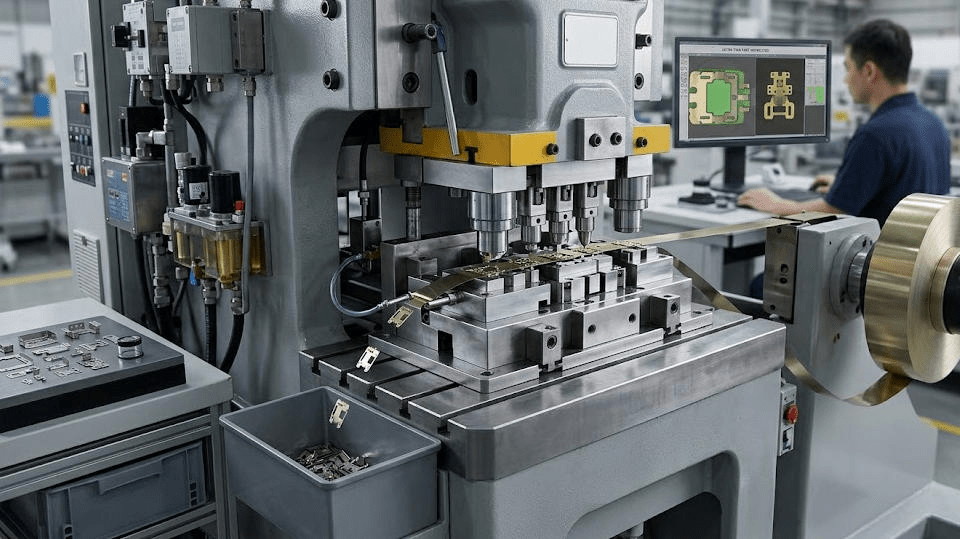
One of the greatest challenges in manufacturing ultra-thin metal stamping parts is keeping stable material movement throughout the production process. Thin metal strips can quickly wrinkle, stretch, or drift off alignment if the feeding systems are not managed properly, and this becomes noticeable very fast on production lines.
To solve this, manufacturers often rely on automated feeding setups that include precision rollers, servo motors and tension regulation mechanisms. In addition, sensors constantly watch the material position and feeding precision, then the system makes real-time corrections so the process stays steady.
With advanced feeding technology, material waste tends to drop while product uniformity tends to improve.
5. Burr Control and Edge Quality Improvement
Since ultra-thin metal parts are frequently used in electronic and medical devices, burr-free edges are not optional. Even tiny burrs at the surface can disrupt assembly, affect electrical conductivity, and reduce product dependability.
Manufacturers optimize the cutting clearances and keep sharp tooling in place to reduce burr formation during stamping in a very direct way. Also, extra finishing steps, like electrochemical deburring, laser deburring, precision brushing, and electropolishing, may get added to further enhance the edge quality, even when the part looks “finished” at first glance.
These technologies help deliver clean, smooth edges while also protecting the dimensional integrity of delicate components, without drifting out of spec.
6. Surface Finishing and Functional Coatings
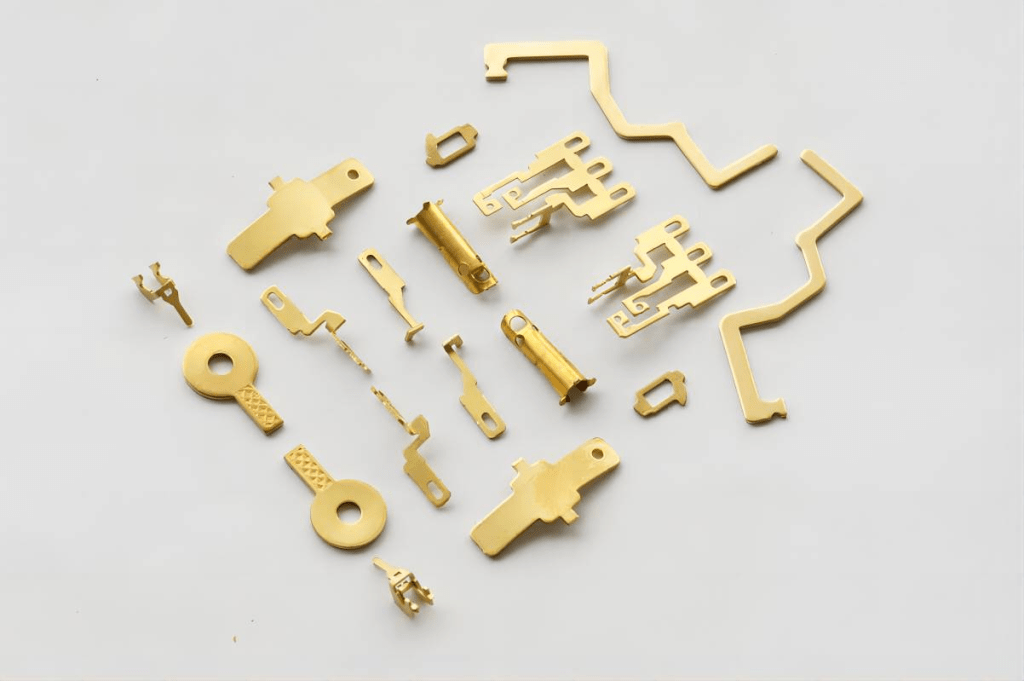
Surface quality is particularly important for ultra-thin metal stamping parts used in high-performance applications.
| Surface Finishing / Coating Technology | Process Description | Benefits | Applications |
| Electropolishing | Electrochemical process that removes microscopic surface irregularities. | Ultra-smooth surface, improved corrosion resistance, reduced contamination. | Medical devices, precision electronics, stainless steel components. |
| Passivation | Chemical treatment that enhances the natural oxide layer on stainless steel. | Improved corrosion resistance without altering dimensions. | Medical instruments, aerospace components, electronic hardware. |
| Nickel Plating | Deposits a nickel layer onto the metal surface. | Corrosion protection, wear resistance, improved conductivity. | Connectors, terminals, automotive electronics. |
| Gold Plating | Applies a thin layer of gold to the component surface. | Excellent conductivity, oxidation resistance, reliable signal transmission. | Semiconductor lead frames, high-end connectors, telecommunications equipment. |
| Tin Plating | Coats parts with a thin tin layer. | Enhanced solderability, corrosion resistance, cost-effectiveness. | PCB connectors, battery contacts, electronic terminals. |
| Silver Plating | Deposits a silver coating on metal surfaces. | Highest electrical conductivity, low contact resistance. | RF components, power connectors, electrical contacts. |
| Anodizing | Electrochemical process primarily used on aluminum parts. | Increased hardness, corrosion resistance, decorative finish. | Aerospace parts, lightweight electronic housings. |
| Zinc Plating | Protective zinc coating applied to steel components. | Corrosion resistance and cost-effective protection. | Industrial hardware, automotive components. |
| Diamond-Like Carbon (DLC) Coating | Thin carbon-based coating with exceptional hardness. | Low friction, wear resistance, extended service life. | Precision mechanical parts, micro-components. |
| PVD Coating (Physical Vapor Deposition) | Vacuum coating process that deposits hard, thin films. | Wear resistance, decorative appearance, improved durability. | Electronic contacts, precision components. |
| PTFE Coating | Fluoropolymer coating that reduces friction. | Non-stick properties, chemical resistance, low friction. | Sliding contacts, precision moving components. |
| Anti-Fingerprint Coating | Specialized surface treatment that resists oils and fingerprints. | Improved appearance and cleanliness. | Consumer electronics, decorative metal parts. |
7. Inspection and Quality Assurance
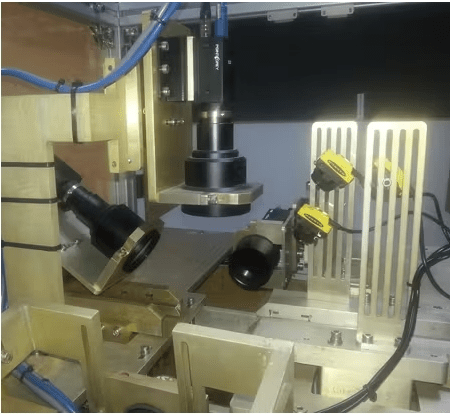
Traditional quality assurance and inspection approaches for ultra-thin metal stamping parts are often not enough because of the tiny dimensions and narrow tolerance windows. Manufacturers relies heavily on advanced inspection technologies like AOI, machine vision, laser measurement, and CMM systems, etc, to catch issues that would otherwise stay hidden.
| Inspection / QA Method | Purpose | What It Detects | Benefits |
| Visual Inspection | Initial quality assessment of finished parts. | Scratches, dents, discoloration, obvious defects. | Fast and cost-effective screening. |
| Automated Optical Inspection (AOI) | High-speed camera-based inspection. | Burrs, cracks, dimensional deviations, missing features. | Non-contact, high accuracy, suitable for mass production. |
| Machine Vision Systems | AI-assisted image analysis for precision inspection. | Surface defects, shape inconsistencies, assembly issues. | Real-time monitoring and automated defect classification. |
| Laser Measurement Systems | Non-contact dimensional measurement using laser technology. | Thickness variations, edge defects, dimensional inaccuracies. | Extremely precise measurements for ultra-thin parts. |
| Coordinate Measuring Machine (CMM) | High-precision geometric measurement. | Dimensional tolerances, hole positions, flatness deviations. | Accurate verification of complex geometries. |
| Optical Comparator | Magnified profile comparison against design specifications. | Profile errors, edge quality issues, contour deviations. | Ideal for small and intricate stamped parts. |
| Surface Roughness Testing | Measures surface texture and finish quality. | Excessive roughness, finishing inconsistencies. | Ensures performance and coating adhesion. |
| Thickness Measurement | Verifies material and coating thickness. | Thickness variation, coating non-uniformity. | Maintains product consistency and reliability. |
| Burr Height Measurement | Evaluates edge quality after stamping. | Excessive burr formation. | Prevents assembly and performance problems. |
| Metallographic Analysis | Examines microstructure and grain characteristics. | Material defects, structural abnormalities. | Confirms material integrity and process effectiveness. |
| Hardness Testing | Measures material hardness and mechanical properties. | Improper heat treatment or material inconsistencies. | Ensures mechanical performance requirements are met. |
| Adhesion Testing | Evaluates coating attachment strength. | Coating delamination or weak bonding. | Verifies durability of plated or coated surfaces. |
| Corrosion Testing | Assesses resistance to environmental degradation. | Premature corrosion or coating failure. | Ensures long-term reliability. |
| Electrical Conductivity Testing | Measures electrical performance. | High resistance, poor conductivity. | Critical for electronic and connector applications. |
| Statistical Process Control (SPC) | Monitors manufacturing consistency through data analysis. | Process drift and variation trends. | Early detection of production issues and defect prevention. |
Industrial Applications of Ultra-thin Metal Stamping Parts
| Industry | Example Ultra-thin Stamping Parts | Functions | Benefits |
| Consumer Electronics | Connectors, battery contacts, EMI shielding components, flexible circuit parts | Electrical connection, signal transmission, electromagnetic shielding | Lightweight, miniaturization, high conductivity |
| Smartphones & Wearables | SIM card holders, charging contacts, antenna components, sensor housings | Device connectivity and compact assembly | Supports thinner and lighter device designs |
| Medical Devices | Surgical instrument components, implantable device parts, diagnostic sensor elements | Precision operation, biocompatibility, reliability | High accuracy, corrosion resistance, miniaturization |
| Automotive Electronics | Sensor terminals, ECU connectors, battery management components | Electrical control and communication | Enhanced reliability and weight reduction |
| Electric Vehicles (EVs) | Battery tabs, busbars, connector terminals, motor control contacts | Power distribution and battery connectivity | Improved energy efficiency and compact battery design |
| Aerospace & Aviation | Precision brackets, shielding components, sensor parts, control system contacts | Lightweight structural and electrical functions | Weight reduction and high-performance reliability |
| Telecommunications | RF shielding parts, connector pins, antenna elements | Signal transmission and electromagnetic protection | High-frequency performance and compact equipment design |
| Semiconductor Manufacturing | Lead frames, micro-connectors, precision contact components | Chip packaging and electrical connectivity | High precision and mass-production capability |
| Renewable Energy | Solar cell connectors, battery storage contacts, power management terminals | Energy transfer and electrical control | Improved energy efficiency and durability |
| Industrial Automation | Precision switches, relay contacts, sensor components | Monitoring and control systems | Long service life and reliable operation |
| Defense & Military Equipment | Electronic contacts, communication system components, sensor parts | Mission-critical electronic performance | High durability and environmental resistance |
| Consumer Appliances | Control panel contacts, micro-switches, electrical connectors | User interface and electrical control | Cost-effective mass production and reliability |
Final Words
Manufacturing ultra-thin metal stamping parts is a pretty specialized process, where advanced materials, precision tooling, sophisticated equipment and strict quality control all get mixed together in a disciplined way. Each phase, from material selection and tooling design to the actual stamping, then finishing, and finally inspection has to be managed in a careful manner, so the output product quality stays steady.