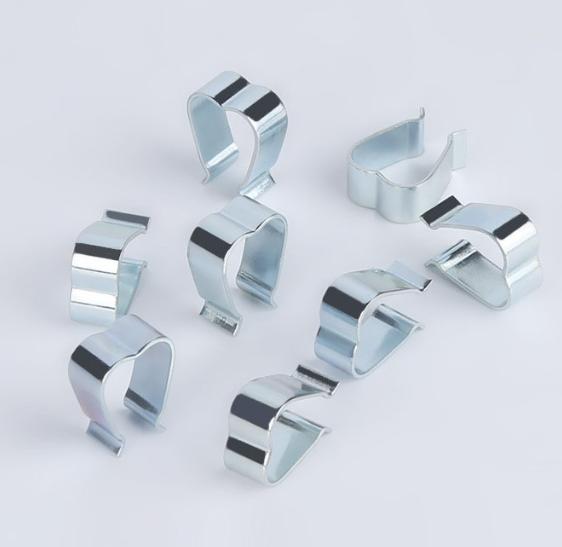
How to Choose Metal Stamping Materials for Your Project
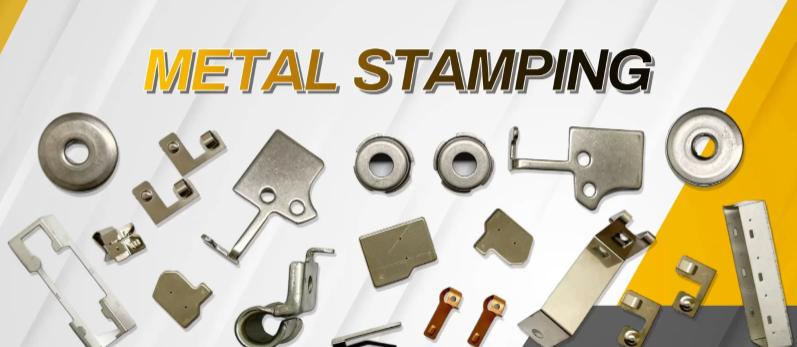
In modern manufacturing, metal stamping is an efficient and cost-effective processing method widely used in industries such as automotive, electronics, home appliances, and industrial equipment. Throughout the stamping process, the choice of material directly affects product performance, cost, and service life.
So, what are the common metal stamping materials? What are the differences between them? And how can you choose the most suitable material for your project? This article will provide you with the answers!
Table of Contents
Part 1. What are Metal Stamping Materials?
Materials for metal stamping comprise metals used in stamping operations, usually in the form of sheet metals or coils. These materials constitute the entire basis of metal stamping and determine the quality of the final product.
To be used in stamping operations, metals for stamping must be ductile and formable, ensuring that they can easily be shaped without breaking, as well as strong enough for durability. Additionally, some of these metals must also be corrosion-resistant for longer product lifespan.
The use of the right metal in stamping operations makes the process efficient, reducing costs.
Part 2. Common Types of Metal Stamping Materials
In actual production, different applications and product requirements call for different types of metal stamping materials. The properties of these materials not only affect the quality of the final product but also have a direct impact on processing difficulty and cost control. Below are some of the most commonly materials used in metal stamping and their characteristics:
1. Steel
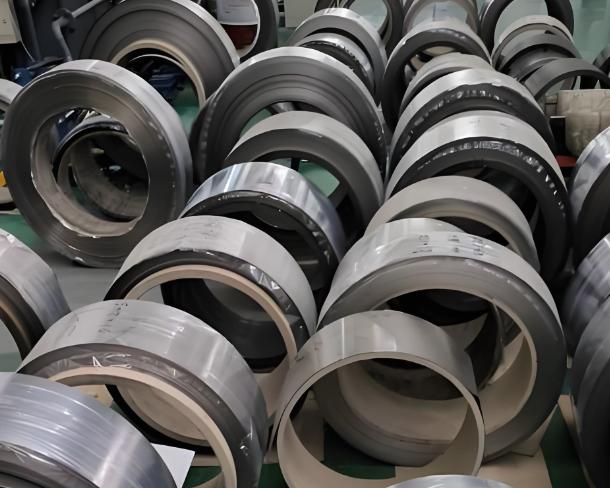
Steel is among the most used materials for metal stamping. Depending on the composition, steel can be classified as carbon steel and stainless steel.
The benefits associated with steel include high strength, cost-effectiveness, and wide applicability. However, carbon steel may rust and may require special surface treatment. In addition, the high hardness may cause tool wear during stamping.
The uses of steel include automotive parts, building components, and machinery.
2. Aluminum
Because of its light properties, aluminum is increasingly used in modern manufacturing, particularly in situations where weight is a factor. Additionally, its natural corrosion resistance and ease of working make it ideal for making complex parts using a stamping process.
At the same time, lower weight, ease of processing, and natural resistance to corrosion amount to its main advantages. However, it is much weaker than stainless steel and therefore more costly per pound as compared to ordinary carbon steels.
It is widely used in electronic housings, aerospace components, and consumer electronics.
3. Copper
Copper is a necessary component in the fields of electronics and electric parts, mainly because of its speciality in electrical and thermal conductivity. Any success in high-precision stamping applications for the metal can further be attributed to improved properties concerning adequate cold- and hot-rolling and minor work hardening.
Class wedges its properties: high conductivity; superior transfer of heat; and resistance against corrosion. Being of a higher cost, copper tends to carry less toughness and may so not be recommended for applications of structure.
Electric parts, connectors, and printed circuits are common uses.
4. Brass
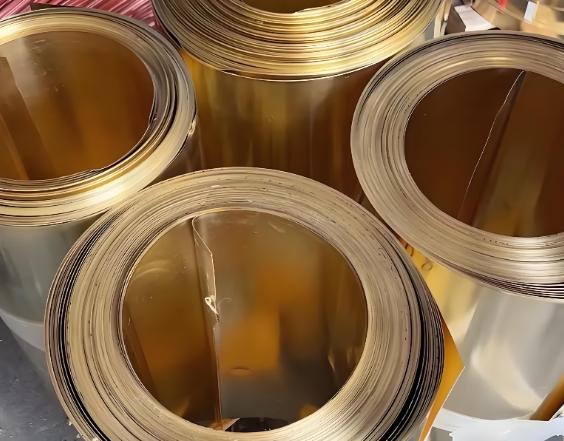
Brass is an alloy formed by mixing copper with zinc, which gives this alloy its distinctive features of both beauty and usability.
The highly workable metal, even though it is susceptible to some level of corrosion, appears to retain its appealing metallic shine. Copper still cannot rival steel in terms of strength and costs more than many white metals anyways.
Decorative items, hardware, and some precision parts are the items usually associated with brass.
5. Titanium
Titanium is a high-strength, lightweight material with good resistance to corrosion. Demand for titanium continues to grow while particularly high-end applications call for it.
One of the biggest benefits of titanium is that it is very strong while being lightweight. Moreover, it does not corrode, and its service life is very long. On the flip side, processing titanium is very expensive; it requires very high-tech equipment and plenty of experience in working with it.
It is mainly utilized for medical instruments, aeronautics and higher-end types of industrial equipment.
6. Galvanized Steel
Galvanized steel consists of regular steel coated with a layer of zinc for better corrosion resistance.
It has better corrosion resistance than carbon steel while offering good strength and low cost at the same time. However, the zinc coating may get damaged during stamping.
It is used for home appliance enclosures, automotive components, and building materials.
7. Cold Rolled Steel
Cold-rolled steel is generally meant to be processed under ambient conditions to a smoother surface finish and superior dimensional accuracy, which is best suited for precision stamping activities.
Positive yield qualities involve very good surface quality and dimensional stability, which are suitable for application in galvanized or coated materials. Although if treated improperly, internal stress may result in cracks surfacing during processing.
It is mostly preferred for various intended uses such as precision machine parts, electric enclosures, and high-speed industrial tools.
8. Nickel Alloys
Nickel alloys are known for their remarkable resistance to heat and corrosion, making them opportune for extreme environments.
They assure the possession of high oxidation resistance and high temperature resistance as per the requirement, suitable for high-temperature necessities. All other properties are such that they can be inferred to withstand most corrosive media. Nevertheless, cost bucks and they have processes that would be difficult to meet.
Applications include aerospace, energy equipment, and chemical industries.
9. Zinc
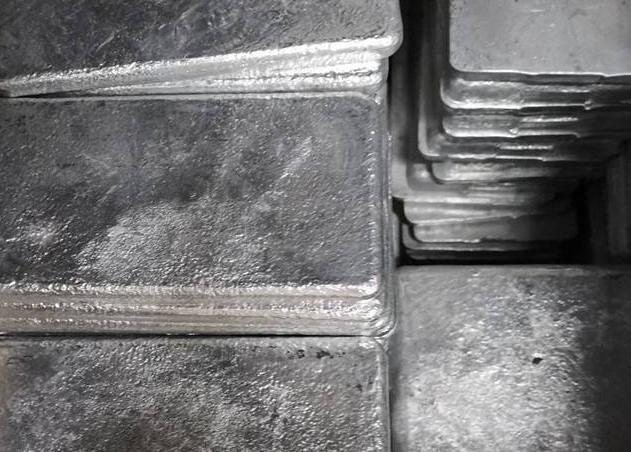
Zinc is a relatively soft material, typically used in applications that require good formability but not high strength.
Its advantages include easy processing, good formability, and some level of corrosion resistance. However, its low strength limits its use in load-bearing applications.
It is commonly used in small hardware parts, housings, and decorative components.
10. Phosphor Bronze
Phosphor bronze is a copper alloy containing phosphorus which is familiar for its good elasticity and wear resistance, which is useful for precise electrical components.
In such cases, besides having low elasticity, there is fatigue resistance and corrosion resistance. Such properties are very essential when considering components under a repeated stressing endowment. Nonetheless, its cost is somewhat high, and it therefore must be processed accurately.
The usual applications cover springs, electrical connectors and contacts.
The selection of materials for the metal-stamping process varies greatly and one can choose from a wide range of basic metals to high-performance alloys. The proper selection will depend on the requirements for strength, intensity of the operating environment, budget, and the possible technology of processing. Further classifications can be exacted for materials based on the grade in which they are used.
| Material | Key Advantages | Main Disadvantages |
| Steel (Carbon / Stainless) | High strength, low cost, widely used | Carbon steel rusts easily, high hardness |
| Aluminum | Lightweight, corrosion-resistant, easy to form | Lower strength than steel, higher cost |
| Copper | Excellent electrical & thermal conductivity | Expensive, relatively soft |
| Brass | Easy to machine, good appearance, corrosion-resistant | Lower strength than steel, higher cost |
| Titanium | High strength-to-weight ratio, excellent corrosion resistance | Very expensive, difficult to process |
| Galvanized Steel | Good corrosion resistance, cost-effective | Coating may be damaged during stamping |
| Cold Rolled Steel | Smooth surface, high precision | Internal stress may cause cracking |
| Nickel Alloys | High temperature & corrosion resistance | High cost, difficult to process |
| Zinc | Easy to form, good corrosion resistance | Low strength |
| Phosphor Bronze | High elasticity, wear & fatigue resistance | Expensive, processing complexity |
Part 3. How to Choose the Right Metal Stamping Materials?
Choosing the right metal stamping material is critical in ensuring product performance, manufacturing efficiency, cost-effectiveness, and delivery. There is no one best material suitable for all jobs, as the variables would differ from one application to another. Variables include such factors as strength, weight, corrosion resistance, processing difficulties, and budget. It is essential that you choose the most suitable material for your project.
The following table is a quick reference to guide you in determining the appropriate material selection criteria based on common applications.
| Selection / Requirement | Favorable Material | Preferred Materials / Applications |
| High strength | Steel, Stainless Steel, Alloys | Suitable for form-bearing or high-strength applications, such as car parts and industrial devices |
| Lightweight | Aluminium, Titanium | Reduced weight without losing strength; used in aerospace, electronics, and portable devices |
| Electrical / Thermal Conductivity | Copper, Phosphor Bronze | Best conductive and heat-conductive materials for internal connections, circuits, and precise electronic parts |
| Resistance against corrosion | Stainless Steel, Aluminium, Titanium, Nickel Alloys | Ideal for outdoor, residue-prone, or chemical environments |
| Cost-sensitive applications | Carbon Steel, Galvanized Steel | Good cost-performance ratio for large-scale production |
| Aesthetic / Finish Appearance | Stainless Steel, Brass, Aluminium, Steel, etc. | Provides visual sparkle and good finishing; used for surface decoration |
| Hardness | Special Steel, Copper, Aluminium | Suitable for plating or coating; maintains exact dimensions |
| Hard / Soft workability | Aluminium, Copper, Brass, Zinc | Extremely ductile materials reduce tool wear and scrap |
| High Temperature | Nickel Alloys, Titanium, Stainless Steel | Maintains strength and corrosion resistance in extreme or high-temperature environments |
| Spring Action / High Fatigue Resistance | Phosphor Bronze, Stainless Steel | Ideal for springs, connectors, and components requiring high fatigue resistance |
Factors Affecting the Performance of Metal Stamping Materials
Apart from material thickness, perforation performance is crisply influenced by notebook factors.
1. Material Thickness
Material thickness does affect the perforation capability of metal. Increased declining material thick or poor material slab can lead to differentiation due to the peeling of the materials itself, characterizing die wear and cracking or deformation.
Consequently, the material thickness should be designed suitably according to the part structure and strength needs for a large capacity factor in the car stamping process design.
2. Surface Finish
The roughness or the surface treatment, or plating of the material, strongly affects the stamping result. Rough and oily surfaces enhance friction, intensify die wear, and increase the scrap rate. Proper treatment of the surface will not only guarantee the external appearance of the finished part but also extend the lifespan of the die.
3. Tooling Design
Well-designed dies have, maybe, the biggest influence on the quality of the stamped part. Issues such as die structure, cutting clearance, and angle designs must be optimized based on the material’s properties and part geometry. Proper die design will reduce burrs, rough edges, and stress concentration, leading to part-gallery accuracies and increased production efficiency.
4. Process Parameters
The stamped process parameters, such as stamping force, stamping velocity, lubricant, and stamping sequence, directly affect the quality of the workpiece. When these are proper for certain materials and types of parts, the material utilization and the consistency in product integrity can be maximized, thus extending the life of tooling.
The proper selection of a metal is not enough to ensure high-quality stamped parts. In addition, the control of the material thickness, surface finish, tool design, and presswork parameters is crucial for the production of high-quality stamped parts in an efficient and very reliable manner.
KENENG Metal Stamping Service
As a professional metal processing manufacturer with rich export experience in metal processing for decades, KENENG specializes in offering high-quality metal stamping solutions for customers. We can provide various metal stamping materials, including steel, aluminum, copper and copper alloys, titanium alloys, nickel alloys, etc., which can meet various customer demands for performance, strength, and precision.
With our advanced production capacity and rich processing experience, we can process products according to customer samples or drawings, which enables high-precision stamping products with an accuracy of ±0.01mm. Meanwhile, we can provide customers with wire cutting, EDM, CNC machining, and injection molding services, which can help customers solve their demands comprehensively.
Irrespective of small-batch custom requirements or large-scale production orders, we offer professional counseling and dependable delivery, through which we aid our customers in reducing costs while raising product competitiveness. With a well-defined quality management system (IATF 16949, ISO 9001:2015) and patented technology, our products have an extraordinary yield rate of 99.83% and are successfully traded throughout 180 countries and regions worldwide. If you are looking for a steadfast metal stamping manufacturer, KENENG is the great choice!